Applications of Gestalt Theory in Education
Gestalt theory is considered one of the most influential theories in the field of education, as it provided a different understanding of the learning process that focuses on understanding and insight rather than mechanical memorization.
Its educational applications aim to make the student an active partner in building knowledge, not just a receiver of information.
Designing Educational Activities According to Gestalt Principles
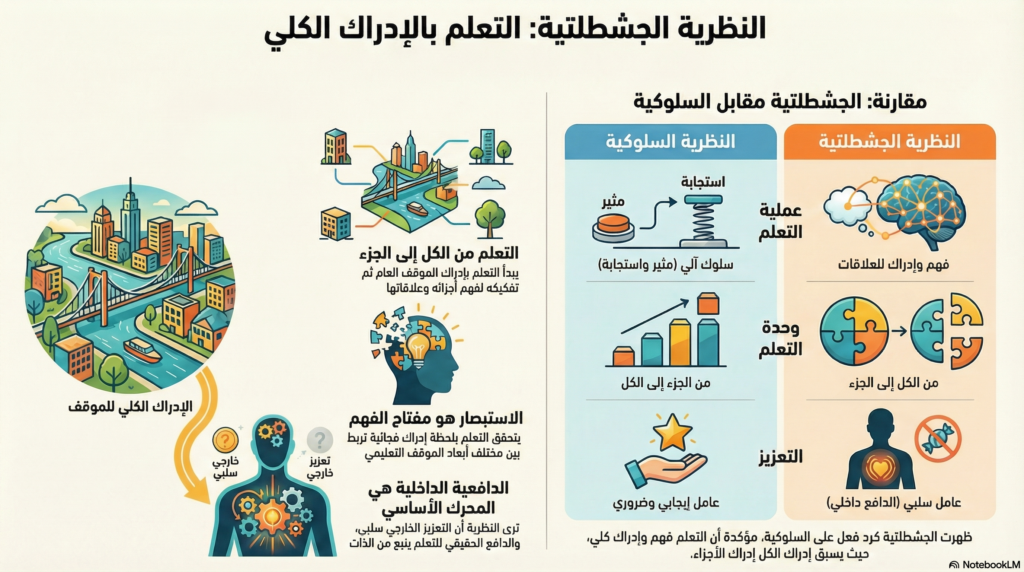
The theory emphasizes the importance of presenting educational material as a whole and interconnected before moving to the parts.
The Gestalt teacher starts by explaining the general concept of the lesson, then breaks it down into its constituent elements.
For example: When teaching a literary text, the general meaning of the text is first reviewed, then the vocabulary and structures are analyzed afterward.
The Role of the Teacher in Guiding the Process of Insight
The teacher in the Gestalt approach is not a transmitter of information, but a guide to the educational experience.
He prepares the educational situation in a way that allows students the opportunity to discover relationships themselves, by asking questions and stimulating analytical thinking.
It also encourages learners to discover and correct their own mistakes, because this type of learning is more stable and continuous.
Applying Perception Laws in Visual Education
In instructional design, Gestalt laws such as proximity, similarity, and closure are used to organize visual materials in a way that attracts the learner’s attention and facilitates understanding.
For example, a teacher can use similar colors or shapes to clarify relationships between concepts.
Also, using complete images before details helps learners perceive the meaning more clearly.
Examples of Applying the Theory in the Classroom
-
When teaching mathematics, the teacher can present the problem as a whole and then analyze the solution steps.
-
In science classes, the teacher starts with a practical experiment that shows the concept and then moves to explaining the phenomena.
-
In Arabic language, texts are first presented to understand the general meaning before analyzing words or rules.
In this way, education becomes an interactive and inferential process focused on building meaning rather than rote learning.
Comparison Between Gestalt Theory and Behavioral Theory
Both theories share an interest in studying the learning process, but they differ fundamentally in their philosophical foundations and methods of interpreting human behavior.
Points of Agreement
-
Both seek to explain how behavior or learning is acquired.
-
Both relied on the experimental method in studying psychological phenomena.
-
Both contributed to the development of education in different ways.
Points of Difference
| الجانب |
الجشطلتية |
السلوكية |
| طبيعة التعلم |
عملية عقلية داخلية تعتمد على الفهم والاستبصار |
عملية ارتباط بين مثير واستجابة |
| دور المتعلم |
فاعل ومفكر ومكتشف للعلاقات |
سلبي يتلقى المثيرات ويستجيب لها |
| الهدف من التعلم |
الفهم العميق للعلاقات والمعاني |
اكتساب سلوك محدد من خلال التكرار |
| طريقة التعلم |
الكل أولاً ثم الأجزاء |
الأجزاء أولاً ثم الكل |
| أدوات التعلم |
الملاحظة، التفكير، الفهم |
التكرار، التعزيز، الممارسة |
How Did Education Move from Behavior to Understanding?
Gestalt theory contributed to shifting the focus from behavioral outcomes to cognitive processes.
The goal was no longer just for the student to learn the correct answer, but to understand why it is correct.
This approach paved the way for the emergence of modern cognitive theories such as Piaget’s theory of cognitive development and Bruner’s theory of discovery.
Criticism of Gestalt Theory
Despite the significant impact of Gestalt theory in psychology and education, it was not without criticism. It faced a number of observations from contemporary researchers.
Most Prominent Scientific Criticisms
-
Excessive focus on the cognitive aspect while neglecting other aspects such as motivations and emotions.
-
Lack of precise experimental research that validates its principles in real-life situations.
-
Most of its experiments being limited to small samples of individuals or animals like monkeys, which reduces the generalizability of their results.
Areas That Need Development
Some researchers believe that Gestalt theory needs to integrate its ideas with modern cognitive approaches, especially in light of developments in neuroscience and artificial intelligence, to better understand how the brain processes information.
Its Relevance in Modern Education
Despite criticisms, Gestalt theory remains highly important in the field of education because it places the learner at the center of the educational process and encourages learning based on understanding and analysis rather than rote memorization.
The Impact of Gestalt Theory on Modern Psychology
Gestalt theory has had a wide impact on the development of psychological thought, particularly in the fields of perception, knowledge, and learning.
Its Influence on Cognitive Perception Theories
Gestalt theory is considered the foundation upon which modern cognitive perception theories were built, as it shifted the focus from external behavior to internal mental processes.
It also inspired researchers to develop concepts such as “holistic information processing” and “mental maps”.
Its Connection to Human and Cognitive Psychology
Gestalt theory helped pave the way for the emergence of human psychology, which focuses on self-understanding and conscious perception, and it also influenced the development of cognitive and constructivist theories that are considered a natural extension of its ideas.
Its Presence in Design, Advertising, and Education
Gestalt principles are widely used in graphic design, advertising, and architecture because they explain how people perceive shapes and visual relationships.
In education, they are still used to build interactive curricula and design activities based on holistic understanding.
Frequently Asked Questions (faqs)
1. What does the word “Gestalt” mean?
The wordGestalt(Gestalt) is of German origin and means “shape” or “form” or “holistic pattern”.
It expresses the core idea of the theory, which is that humans perceive things as integrated wholes, not as separate parts.
2. Who are the founders of Gestalt theory?
The Gestalt school was founded by three German psychologists:
-
Max Wertheimer – Pioneer of the theory.
-
Kurt Koffka – Contributed to the global dissemination of the theory.
-
Wolfgang Köhler – Presented experiments on insight learning with monkeys.
3. What is the difference between Gestalt theory and behavioral theory?
-
Gestalt: Focuses on holistic understanding and insight as a means of learning.
-
Behavioral: Focuses on observable behavior and learning through repetition and reinforcement.
In other words, Gestalt views learning as an internal mental process, while behavioral theory considers it a connection between stimulus and response.
4. What is meant by insight learning in Gestalt theory?
Insight learning is a type of learning that occurs when a person suddenly perceives the relationship between elements of a situation and reaches a solution consciously and systematically, as in Köhler’s experiments with monkeys that realized how to use tools to reach food.
5. What are the Gestalt laws of perception?
The most prominent laws that define how humans perceive things are:
-
Law of proximity: Elements that are close together are seen as a single unit.
-
Law of similarity: Similar elements are grouped together.
-
Law of closure: The mind completes incomplete shapes.
-
Law of continuity: Humans tend to perceive continuous lines.
-
Law of figure and ground: The mind distinguishes between the main figure and the surrounding background.
6. How can Gestalt theory be applied in education?
It can be applied through:
-
Presenting the general concept of the lesson before details.
-
Encouraging students to discover relationships themselves.
-
Using organized visual media according to Gestalt laws.
-
Focusing on understanding and insight rather than memorization.
7. What are the main criticisms of Gestalt theory?
-
Its excessive focus on mental perception without considering social and emotional factors.
-
Its reliance on limited experiments that have not been generalized to all groups.
-
The lack of a strict experimental approach like behaviorism.
However, Gestalt theory remains deeply influential in contemporary education.
8. Is Gestalt theory still used in modern psychology?
Yes, many Gestalt ideas are still used in cognitive psychology, curriculum design, visual design and advertising, and even in fields like artificial intelligence for understanding how information is processed visually.
9. What is the relationship between Gestalt theory and active learning?
Gestalt theory supports the philosophy of active learning because it makes the student the center of the educational process, driving them to think and analyze, and discover meanings for themselves instead of rote memorization of information.
10. Why is Gestalt theory important for teachers?
Because it gives them practical tools to design lessons that encourage deep understanding, and helps improve the visual and cognitive comprehension of students, making the educational process more effective and engaging.
Conclusion
Gestalt theory is one of the most influential theories in the history of psychology, as it provided a new perspective for understanding learning and perception based on the whole and organization rather than fragmentation and simple analysis.
And despite more than a century since its emergence, its principles remain present in modern psychology and contemporary education.
Gestalt philosophy reminds us that true understanding is only achieved when we see the whole picture, whether in learning or in life, and that humans by nature tend to seek order and meaning in everything they perceive.