books

Innovative Scientific Title: How to Choose an Innovative Title

22 April 2026
Views (5 views)
Innovative Scientific Title: How to Choose an Innovative Title

How do I choose an innovative title for scientific research?Choosing a scientific research title is an essential step that paves the way for the study’s success and accurately expresses its content. It is the first thing that readers or committee members see, and it forms the first impression about the researcher’s seriousness and awareness of their research problem. Despite the title’s simple form, formulating it requires a delicate balance between scientific accuracy, clarity, and innovation.

In this article, we will provide you with a comprehensive practical guide on how to choose anscientific researchdistinctive title, covering implementation steps, quality criteria, real examples, and the most common mistakes to avoid. We will also introduce you to a support service that helps you craft your academic title professionally.

Why Is Choosing the Title a Crucial Step in Research Success?

Some may think that the research title is just a formal detail, but the reality is that the title plays a fundamental role in the study’s success on multiple fronts. It is the first gateway through which readers or reviewers get a glimpse of the research content, and it is later used for academic indexing, search engines, and scientific journals.

Here Are the Main Reasons That Make Choosing the Title a Crucial Step:

  • It attracts attention and forms the first impression:
    A strong and direct title catches the reader’s attention and arouses their curiosity to read the research or at least its abstract.

  • It accurately defines the research framework:
    Through it, the reader knows the general field, the specific topic, and the problem that the researcher addresses.

  • It contributes to evaluating the researcher’s seriousness:
    Formulating a logical and methodical title reflects the researcher’s understanding of their topic and their ability to express themselves scientifically.

  • It is used for research indexing and understanding its specialization:
    Innovative and clear titles make it easier for other researchers to find the study, and they help journals and databases archive and classify it.

  • It affects publication and academic acceptance opportunities:
    Many peer-reviewed journals and academic committees pay great attention to the quality of the title when accepting scientific papers.

In short: The title is not just a “name” for the research, but it is a smart and precise summary of its content, reflecting the study’s identity and determining its direction.

Steps to Choose a Scientific Research Title

Choosinga researchdistinctive title does not happen randomly, but goes through several studied stages that help you reach an accurate and appropriate formulation for your scientific topic. Here are the practical steps that are recommended to be followed:

  1. Determine the main study area
    Start by identifying the general academic field that your study belongs to (such as: Education, Management, Media, Law…). Then move on to specializing your interest in a specific sub-field (such as: E-learning – Transformational leadership – Digital media…).

  2. Formulating the research problem
    After determining the field, think about the problem or phenomenon you intend to study. What do you want to understand or measure? What question forms the core of your research?
    For example: “Decrease in student motivation in e-learning”.

  3. Reviewing literature and previous studies
    Look at previous research on the same topic or field. The goal is not to copy, but to avoid repetition and draw new ideas that help you formulate a different title with scientific value.

  4. Choosing appropriate keywords
    Identify the essential terms that the title should contain (such as: effect, relationship, trends, strategy, skills…). Ensure they are accurate and recognized in your academic field.

  5. Formulating the initial title (draft)
    Try writing more than one initial version of the title. Don’t look for perfection from the first attempt, but put several alternatives and compare them later.

  6. Testing the title linguistically and methodologically
    Ask yourself: Is the title clear? Does it reflect the study’s content? Can it be shortened without losing meaning? Does it match the methodology used?

  7. Requesting feedback from a supervisor or expert
    Present the title to your academic supervisor or a trusted researcher in the same field, and benefit from their notes to develop it.

  8. Final modification and verification of compliance
    After review, make the necessary modifications, and ensure that the title meets the university’s requirements (in terms of word count, language, style…).

💡 Practical example:
Problem: Decline in writing skills among middle school students
Methodology: Quasi-experimental
Result:
“The effect of using mind maps strategy in developing writing skills among middle school students in Saudi Arabia”

What Are the Characteristics of a Good Title in Scientific Research?

After following the steps to choose the title, it is important to ensure that the title you have chosen meets the basic scientific and linguistic criteria that distinguisha researchgood title. Here are the main characteristics that should be present in the academic title:

  1. Scientific accuracy
    A good title accurately reflects the research field and problem without exaggeration or generalization. It must be precise in choosing the scientific terms and concepts used.

  2. Clarity and simplicity
    The title should not be vague or linguistically complex. The reader should understand its meaning upon reading it without needing additional interpretation.

  3. Comprehensiveness without lengthiness
    The title should cover the essential aspects of the research (variables, category, field) without being excessively long. The appropriate length is usually between 10-15 words.

  4. Absence of results or premature judgments
    The title should not contain conclusions or research results; it should only refer to the relationship, impact, or hypothesis.

  5. Connection to the methodology used
    It is preferable that the title reflects the type of methodology followed (quantitative – qualitative – experimental – analytical…), or the nature of the relationship studied (impact – relationship – comparison – evaluation…).

  6. Identification of the study category or population
    If the study is field or applied, it is useful for the title to indicate the target group or environment in which the study was conducted (such as: high school students, mathematics teachers, emerging institutions…).

  7. Absence of linguistic errors
    Any spelling or grammatical error in the title weakens the credibility of the research. Therefore, it must be carefully proofread linguistically.

  8. Innovation and distinction
    Ensure that the title is innovative and not literally repeated in previous research. Using a new linguistic construction or an unexplored research angle gives your research an additional advantage.

💡 Illustrative example:
Good title:
“The effectiveness of using artificial intelligence applications in improving academic achievement among high school students in physics”

Inaccurate title:
“Artificial intelligence and its impact on education” ← general, vague, and unspecified

How Do I Write a Scientific Thesis Title Innovatively?

Formulating an innovative scientific title does not mean using literary or strange phrases, but rather depends on combining academic accuracy with appeal and distinction. To write a scientific thesis title in an innovative and effective way, here are these guidelines:

  1. Start from the research gap
    Read previous studies and identify what they lack or have not addressed in depth. An innovative title often expresses a new angle or unused perspective.

Example: Instead of “The impact of e-learning on achievement”
Write: “The effectiveness of blended learning models in improving academic achievement among high school students in the virtual environment”

  1. Use modern or contemporary terminology
    Using concepts related to recent developments in the field gives the title a modern touch.

Example:
“The impact of using augmented reality technologies in developing spatial thinking skills among architectural engineering students”

  1. Focus on the category or application environment
    The more the title is customized to a specific community, the more distinctive it becomes and connected to reality.

Example:
“Analysis of media discourse on health crises on Saudi social media platforms: a case study on Twitter”

  1. Make the title specific and measurable
    Do not use absolute words like “comprehensive study” or “overview”. Choose words that reflect the aspect you will actually address.

Inaccurate example: “Digital marketing in the Kingdom of Saudi Arabia”
More accurate example: “Entrepreneurs’ attitudes towards using Instagram advertisements in marketing home products in the Saudi market”

  1. Use linguistic structures flexibly
    You can choose the question format, the nominal sentence, or a sentence containing two or more variables, as long as it is coherent and clear.

Example in question format:
“What is the effectiveness of project-based learning in developing research skills for preparatory year students?”

  1. Avoid imitation or literal copying
    Some ready-made titles circulating online may tempt you, but using them as is weakens the value of your research and exposes you to similarity or repetition.

Tip: Compare your initial title with several recent study titles, and ask yourself: Does this title offer something new? Can it be distinguished among 10 similar titles?

✳️ Summary:
The innovative title in scientific research is one that combines modernity, accuracy, specificity, and applicability.


Common Mistakes to Avoid When Choosing a Research Title

Despite the importance of the title in scientific research, many students and researchers make common mistakes while formulating it, which leads to weakening its impact or even rejection by supervision committees or scientific journals. Here are the most prominent mistakes to avoid:

  1. Ambiguity or excessive generality
    Vague or unclear titles make it difficult for readers to accurately determine the research topic.

Inaccurate example: ‘Education and its impact on students’
Problem: Unspecified — what type of education? What impact? What category of students?

  1. Excessive length or inappropriate brevity
    A very long title confuses the reader, while a very short title may hide important research elements.

Rule: A good title usually ranges between 10 to 15 words.

  1. Repeating titles or copying them from previous studies
    Using a title identical to a previously published study is considered academic misconduct and may lead to rejection of the work or accusations of plagiarism.

  2. Formulating the title to indicate research results
    It is prohibited to include results or conclusions in the title, as it should express the research topic, not its summary.

Common mistake: ‘Proving the effectiveness of strategy X in improving achievement’
Correct: ‘The effect of strategy X in improving achievement…’

  1. Using non-academic language or emotional terms
    Expressions that are promotional, personal, or non-scientific should be avoided, such as ‘best method’, ‘amazing’, ‘excellent’, ‘very useful’, etc.

  2. Combining more than one topic in a single title
    Some researchers try to include more than one focus in the title, which makes it lose focus.

Poor example: ‘The effect of educational games on academic achievement, emotional intelligence development, and improvement of social relationships among middle school students’

  1. Neglecting the category or field
    A title without specifying the category (such as elementary students, science teachers, or small businesses) makes the study unclearly directed.

  2. Weak ordering or linguistic formatting
    Even with a good idea, a disorder in word arrangement or punctuation can weaken the overall impact of the title.

✳️ Important reminder:
Before adopting your research title, seek your supervisor’s opinion or a review from an academic specialist. Early review of titles saves you many revisions later.

Examples of Innovative Scientific Research Titles

The benefit of any theoretical guide is incomplete without practical examples that help researchers visualize successful models. Here is a collection of innovative and distinguished titles in several fields, from which you can draw inspiration for formulating your own research title:

🔹 in Education:

  • ‘The effect of using the flipped learning strategy in developing reading comprehension skills among high school students’

  • ‘The effectiveness of digital educational games in improving calculation skills among fourth-grade elementary students’

🔹 in Management:

  • ‘The impact of digital leadership on the performance of work teams in emerging technology institutions in Saudi Arabia’

  • ‘The role of organizational flexibility in enhancing business sustainability during crises: An applied study on the tourism sector’

🔹 in Media:

  • ‘Analysis of social media platforms’ discourse in covering natural disasters: A case study on Jeddah floods’

  • ‘The effect of using influencers in government awareness campaigns on the behavior of Saudi youth’

🔹 in Law:

  • ‘Legal controls for the use of artificial intelligence in judicial procedures in the Kingdom of Saudi Arabia’

  • ‘The legislative regulation for protecting personal data in the e-commerce environment’

🔹 in Health and Nursing:

  • ‘The effect of electronic health awareness programs in improving diabetes prevention behaviors among youth’

  • ‘Evaluation of the quality of nursing care provided in government emergency departments: A comparative study’

🔹 in Religious Sciences:

  • ‘The effect of differences in fatwas due to time and place: An analytical applied study in contemporary issues’

  • ‘Applications of jurisprudential rules in regulating modern financial transactions’

🔹 in Information Technology:

  • ‘The effectiveness of artificial intelligence applications in detecting banking fraud attempts: An applied model’

  • ‘Analysis of user experience for e-learning applications in Saudi universities’

Notes When Reviewing the Examples:

  • Note that each title clarifies the field – problem – tool or method – target category.

  • Do not copy the title, but try to benefit from the construction method and formulation style.

  • If your research combines two specializations (such as media and management), you can blend the appropriate writing styles for each field.

Rules for Writing an Academic Research Title

Writing an academic title in Arabic requires adherence to a set of linguistic and methodological rules that ensure clarity, accuracy, and consistency with scientific research conventions. Here are the main rules to consider:

  1. Adherence to correct grammar and morphology
    The academic title should be written in proper language free from grammatical or morphological errors. It is recommended to have it reviewed by a language specialist or by using reliable linguistic proofreading tools.

Example: “Effectiveness of training programs in developing leadership skills”
(Not: “Effectiveness of training program in developing leadership skills”)

  1. Use nominal style rather than verbal
    The title should preferably be a nominal or direct declarative sentence, without using a verbal style such as questions or commands, unless the research itself is based on a question.

Appropriate example: “Factors affecting administrative decision-making in government institutions”
Less accurate example: “Do psychological factors affect managers’ decisions?”

  1. Arrange words professionally
    The elements of the title should be arranged logically and easy to understand. Place the main term first, then specify the problem or variables, then the category or place if applicable.

  2. Avoid literal translation from English
    When using a translated title, don’t translate it literally; ensure it fits the Arabic style in terms of structure and meaning.

Bad example: “Project-based learning: a functional strategic perspective”
Better: “Effectiveness of project-based learning in developing functional skills among technical college students”

  1. Use appropriate punctuation
    You can use a colon (:) to divide the title into a main title and subtitle, especially in qualitative research or long titles.

Example: “E-learning in Saudi universities: challenges of transformation and future of quality”

  1. Specify the category or geographical environment when needed
    To clarify the context of applied research, it is preferable to mention the target group or place (such as: King Saud University students – primary school teachers – private schools in Jeddah…).

  2. Review the university or scientific journal guidelines
    Each academic institution may set specific formal requirements for titles, such as a maximum word count or citation style. Ensure compliance with these standards.

✳️ Tip:
Write the final title in proper and refined language, then read it aloud: Does it seem clear? Can it be understood without explanation? Does it accurately express the content of your research?

Can the Research Title Be Changed Later?

Yes, the academic research title can be modified even after initial approval, but this modification is subject to academic conditions and controls, especially in postgraduate studies. The title is not fixed forever; it can be developed if there is a research or methodological need for it.

Here are the main points related to modifying the title:

  1. When Is It Advisable to Modify the Title?

  • If there are substantial changes to the research problem or objectives.

  • If the methodology used changes (for example, from descriptive to experimental).

  • When it is discovered that the original title is very similar to a recently published study.

  • If the scientific committee or supervisor suggests methodological or linguistic modifications.

  • To improve clarity or accuracy after progress in writing the theoretical framework.

  1. Who Is Responsible for Approving the Modification?

  • In the master’s or doctoral phase: A formal modification request is submitted to the supervisor, then to the postgraduate studies committee in the college.

  • In the case of publishing a scientific paper: Modifying the title after submitting the paper to a peer-reviewed journal is subject to the acceptance of the editorial board.

  1. Does the Modification Affect the Research Plan?

Yes, modifying the title often requires reviewing the plan or proposal, especially if the modification includes variables, the field of study, or the target group.

  1. Tips for Professional Title Modification:

  • Make the modification evolutionary rather than radical (modify, don’t completely change the idea).

  • Consult your academic supervisor first.

  • Don’t repeat previous formulation errors.

  • Keep a copy of the previous title for comparison or documentation.

💡 Real Example:

  • Original title: “Effectiveness of educational games in developing language skills in children”

  • After modification: “Effectiveness of digital educational games in developing listening and speaking skills among kindergarten children in Riyadh city”

In this case, the modification added: the type of tool (digital), the type of skills, and the target group clearly.

Services for Suggesting and Formulating a Scientific Research Title

If you’re having difficulty formulating a creative and accurate title for your scientific research, it may be best to seek assistance from a reliable academic institution with sufficient expertise to help you choose a title that reflects the content of your study and meets the university’s requirements.

✳️ Why Do We Recommend “idea Study for Research and Development” Company?

Idea Study Company is one of the leading institutions in providing academic support services to researchers in Saudi Arabia and Arab countries, and among its most requested services: suggesting and formulating professional research titles across various disciplines.

Service Features:

  • Suggest a creative title compatible with the specialization field

  • Review the title linguistically and methodologically

  • Formulate multiple alternatives to provide diverse options

  • Ensure compatibility with the university or research institution guidelines

  • Follow-up support in developing the title within the research plan (upon request)

📌 the Service Includes:

  • Bachelor’s research

  • Master’s and doctoral theses

  • Promotion and scientific research papers

  • Initial research proposals (Research Proposals)

    هل تحتاج إلى مساعدة في إعداد خطة بحثك؟

💬 What Do Our Clients Say?

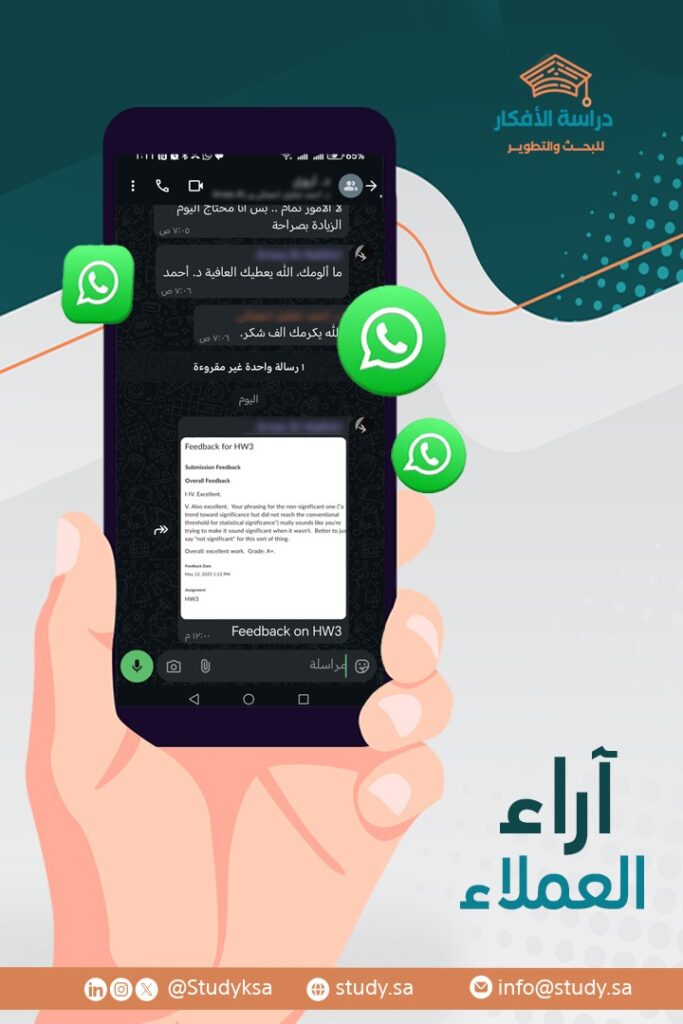
At Idea Study for Research and Development, we take pride in the trust of hundreds of researchers and graduate students who have benefited from our academic services. Here are some of their actual testimonials:

نفتخر بآرائكم – إنجاز يُقاس برضاكم ثقة العملاء هي أعظم إنجازاتنا – رأي عميل يعكس جودة العمل والاحترافية

📞 to Contact Us and Request the Service:

🔗Scientific research title suggestion service – Idea Study Company

Frequently Asked Questions About Choosing a Creative Title for Scientific Research

  1. What is the maximum and natural length for a scientific research title?
    The ideal length for a research title ranges from 10 to 15 words. It should be comprehensive of the problem or phenomenon, category, and methodology without being lengthy or confusing to the reader.

  2. Can the research title be formulated as a question?
    Yes, this is particularly allowed in qualitative or analytical studies, provided that the question is direct, specific, and reflects the general framework of the study.

  3. What is the difference between an attractive title and a precise scientific title?
    An attractive title may draw attention but is not sufficient on its own. A scientific title must be precise, reflects the study’s content, and is free from embellishment or ambiguity. It’s best for the title to combine both attractiveness and precision.

  4. Can the research title be modified after it has been registered with the university?
    Yes, but only upon obtaining official approval from the academic supervisor and the scientific committee of the college. It is advisable to modify the title before starting data collection.

  5. Is there a difference between a research title and a master’s or doctoral thesis title?
    In principle, both follow the same criteria, but a thesis title is often more detailed, clearly indicating the field, methodology, and target category.

  6. Is it preferable to include variables in an experimental study title?
    Yes, in experimental or quantitative studies, it is preferable to include the independent and dependent variables (if possible) to clarify the relationship under study.

  7. How can I ensure that my title is not duplicated?
    Review university and scientific journal databases (such as Google Scholar – Saudi Digital Library), or seek help from an academic institution to review its currency and uniqueness.

  8. What are the mistakes to avoid when formulating a research title?
    Ambiguity – Generality – Literal translation – Including results – Linguistic errors – Titles literally quoted from previous studies.

  9. Can symbols or abbreviations be used within the title?
    It is preferable to avoid them as much as possible. It is not recommended to use unfamiliar abbreviations, while symbols (such as % or &) should only be used when absolutely necessary and with academic approval.

  10. Do academic offices provide only research title formulation service without a complete plan?
    Yes, many specialized institutions – such as “Idea Study for Research and Development” – offer a standalone service for suggesting a creative and suitable research title for your specialization, with the possibility of modifying and developing the title later within a comprehensive plan.

Conclusion

Choosing a creative title for scientific research is not just a formal procedure, but a pivotal decision that expresses your deep understanding of your study topic, and determines the clarity of your objectives and the novelty of your idea. A good title attracts the reader, arouses the interest of review committees, and paves the way for a strong academic research worthy of appreciation and publication.

Whether you are at the beginning of your research journey or in an advanced stage, allocate sufficient time to choose your title, review the selection steps, avoid common mistakes, and review real examples. And if you feel the need for professional support, do not hesitate to consult specialized experts.

💡 Final reminder:

  • Make the title specific, clear, and based on a real problem.

  • Test it linguistically and methodologically before adopting it.

  • Do not settle for the first form – editing is part of scientific creativity.

📍 Advice for researchers:

A strong title doesn’t come from the first attempt, but from research, thought, and experience. Take your time — because a strong beginning means an end closer to achievement.

الموقع الأول في المملكة العربية السعودية للخدمات الأكاديمية

The first site
In the Kingdom of Saudi Arabia
For academic services

Comments

Explore Our Services
11111
Professional Jamovi Data Analysis Services for Students & Researchers
icon
Professional Jamovi Data Analysis Services for Students & Researchers
11111
خدمة تحليل البيانات باستخدام برنامج JASP
icon
خدمة تحليل البيانات باستخدام برنامج JASP
11111
خدمة التحليل الإحصائي النوعي
icon
خدمة التحليل الإحصائي النوعي
11111
خدمة التحليل المختلط بمنهجية Q
icon
خدمة التحليل المختلط بمنهجية Q
11111
خدمة التحليل الإحصائي بلغة R
icon
خدمة التحليل الإحصائي بلغة R
11111
خدمة التحليل الإحصائي ببرنامج E-Views
icon
خدمة التحليل الإحصائي ببرنامج E-Views
11111
خدمة التحليل الإحصائي المتقدم بـ AMOS
icon
خدمة التحليل الإحصائي المتقدم بـ AMOS
11111
خدمة تصور البيانات (Data Visualization) وإنشاء تقارير تفاعلية
icon
خدمة تصور البيانات (Data Visualization) وإنشاء تقارير تفاعلية
11111
خدمة تصميم العروض التقديمية للمناقشة
icon
خدمة تصميم العروض التقديمية للمناقشة
11111
خدمة الباحث المشارك (Co-Researcher Service)
icon
خدمة الباحث المشارك (Co-Researcher Service)
11111
خدمة عمل كتاب إلكتروني وفق المعايير الأكاديمية
icon
خدمة عمل كتاب إلكتروني وفق المعايير الأكاديمية
11111
خدمة كتابة ملخص البحث وترجمته للإنجليزية
icon
خدمة كتابة ملخص البحث وترجمته للإنجليزية
11111
خدمة تلخيص الكتب والمراجع العربية والإنجليزية
icon
خدمة تلخيص الكتب والمراجع العربية والإنجليزية
11111
خدمة تصميم البوسترات البحثية الاحترافية
icon
خدمة تصميم البوسترات البحثية الاحترافية
11111
خدمة ترشيح المجلات العلمية المحكمة
icon
خدمة ترشيح المجلات العلمية المحكمة
Get a free consultation from experts
whatsapp