










books

Scientific Thesis Tips: Essential Tips Before Discussing Your

22 April 2026
Views (8 views)
Scientific Thesis Tips: Essential Tips Before Discussing Your

The moment of discussing the scientific thesis is one of the most important stages in a student’s academic journey, whether at the master’s or doctoral level. It is not just a formal procedure, but a real test of the researcher’s ability to defend their ideas and research outcomes before the academic discussion committee.

It is natural for the student to feel nervous or fearful before this crucial moment. The discussion carries many psychological and scientific challenges, making preparation impossible to ignore. However, with good preparation, this nervousness can be transformed into positive energy that drives you toward excellence.

In this comprehensive guide, we will provide you with a set oftips before discussing the scientific thesis, tried and tested based on the real experiences of researchers who have gone through this experience. We will guide you on how to prepare psychologically and scientifically, how to deal with the discussion committee, in addition to common mistakes to avoid. The goal is for you to arrive at the discussion day confident, self-assured, and prepared for all possibilities.

What Is a Scientific Thesis Discussion?

The scientific thesis discussion is the final stage in the journey of preparing an academic research paper, serving as the culmination of all the efforts made by the student during the thesis preparation period. In this session, the student is required to present their research content before an academic committee composed of professors specialized in the field, then answer their questions and inquiries, which aim to evaluate the extent of their mastery of the subject and understanding of scientific research methodology.

Master’s discussions are often more focused on practical aspects and basic methodology, while doctoral discussions are characterized by a deeper critical and analytical nature, addressing the extent of the scientific contribution the researcher makes in their field.

TheAcademic Committeeplays a fundamental role in guiding the discussion and identifying the strengths and weaknesses of the research, and it is the one that ultimately decides to approve the thesis or request modifications to it.

Also, an important part of the discussion depends on thethesis presentation, which the student is expected to present professionally, using tools like PowerPoint or verbal presentations, where they briefly review the research background, objectives, methodology, results, and recommendations.

Understanding the nature of this session and its requirements helps the student to prepare mentally and psychologically better, reduces the fear of the moment, and puts them in a stronger position to defend their ideas with confidence and calm.


Practical Steps to Prepare Before the Discussion

To be ready for the discussion day, it is not enough to have successfully finished writing the thesis; you must enter the discussion room confident of the details, confident in yourself, and prepared both scientifically and psychologically. Here are practical steps to help you with that:

1. Read the Scientific Thesis Carefully

Above all, you must re-read your thesis completely, as if you hadn’t written it before. Focus on the hypotheses, problem statement, methodology, results, and recommendations. Make sure you can explain each paragraph in both simple and academic language. Many students discover during the final review that they have forgotten certain details or have not noticed potential contradictions.

2. Prepare the Presentation Summary

Prepare a professional presentation that clearly and accurately summarizes your thesis. Whether you use PowerPoint or rely on verbal presentation, ensure your presentation includes: study background, research problem, objectives, methodology, key results, then conclusions and recommendations. Don’t overload with text, focus on key points, and support your statements with charts or illustrations if possible.

3. Review References and Recent Studies

One common mistake is neglecting to review references during discussion preparation. It is important to ensure you remember the key references you used in your research and are aware of the latest studies related to your topic, especially those published in the last two years. This shows the committee that you are following academic developments and not just conveying information.

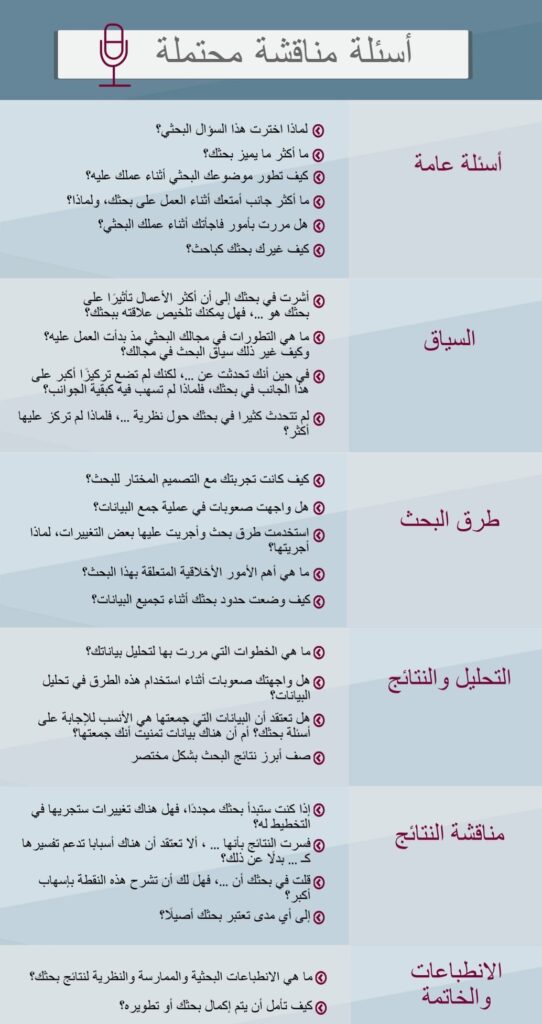
4. Practice Answering Expected Questions

Create a list of potential questions that might be asked during the discussion, and start practicing answering them. You can practice in front of a mirror, with a colleague, or with your academic supervisor. This exercise will help you improve your expression skills, increase self-confidence, and discover any weaknesses in your responses.

These steps are essential for every researcher wondering:How do I prepare for a scientific thesis discussion?OrWhat is the way to prepare for a master’s or doctoral discussion?Good preparation gives you peace of mind and increases your chances of academic success.


Tips for Answering the Discussion Committee’s Questions

After presenting the thesis to the academic committee, begins the stage that worries most students: answering questions. But the truth is that this stage is not a threat, but an opportunity to demonstrate the depth of your understanding of the subject. The key here is to remain calm, honest, and well-versed in your research content.

1. Understanding the Nature of Questions

Questions from thediscussion committeeare usually distributed among three main types:

  1. Critical questions: Aim to evaluate the quality of the research, discuss its methodology, or the logicality of its results. For example: “Why did you choose this theoretical framework?” or “How do you interpret this result?”.

  2. Methodological questions: Relate to how the study was conducted, the tools used, or the sample. For example: “Do you think the measurement tool was actually appropriate?”.

  3. Applied questions: Aim to understand how the research results can be applied in reality. For example: “What recommendations can actually be applied in the field?”.

Understanding the nature of the question helps you determine the angle of your response and prevents you from getting distracted or misinterpreting.

2. Use a Calm Academic Style in Response

When responding to the committee, use a balanced academic style: don’t be overly defensive, nor withdrawn or confused. Use phrases like:

  • “I refer to page number…”

  • “This methodological decision was based on a previous study by…”

  • “There might be other alternatives, but I chose this path for the following reasons…”

Avoid emotional responses or excessive justification, and maintain a calm, confident tone.

3. Acknowledging Scientific Gaps Without Excessive Justification

If a committee member points out a clear weakness in your research, don’t try to deny it or cover it up with lengthy justifications. It’s better to acknowledge it honestly, explaining that you recognize this point and that there is room for development in future research.

This type of response reflects scientific maturity, showing that you are a researcher who understands the limitations of your study and doesn’t claim perfection.

Whether you’re wondering:“How can I answer discussion questions with confidence?”or“How should I handle the defense committee?”these tips will help you get through this part of the session with minimal stress and maximum respect and appreciation from the committee.

نصائح قبل مناقشة الرسالة العلمية


Common Mistakes During the Defense

No matter how well prepared you are, making some mistakes during the defense can negatively affect the committee’s impression of you and possibly the final outcome. Therefore, it’s important to be aware of the most common mistakes and avoid them.

1. Excessive Tension and Loss of Control Over Tone of Voice or Body Language

Nervousness is natural, but if it exceeds acceptable limits, it can negatively affect your performance. You might speak too quickly, stutter, or show signs of anxiety in your facial expressions or hand movements. Therefore, try to take a deep breath before starting your presentation, and remember that you own the message and know it best.

2. Arguing With or Interrupting the Committee

One of the biggest mistakes is interrupting a committee member while they are asking a question, or engaging in unprofessional arguments to defend your point of view. It’s better to listen until the end, then respond calmly and logically, even if you feel the question contains unfair criticism. Your response style leaves a significant impact on the committee’s evaluation of you.

3. Reading Verbatim from Paper or Slides

Over-reliance on reading from paper or slides loses you interaction and makes your performance seem mechanical. It’s preferable to speak fluently without memorizing, and to look at the committee and interact visually with them. A good presentation doesn’t depend on text, but on understanding and communication skills.

4. Neglecting Important Methodological Points

Sometimes, students focus on presenting results or recommendations and forget to explain the methodological details that the study is based on, such as measurement tools, justifications for sample selection, or analysis steps. These details are essential and often the focus of committee questions, so don’t omit them in your presentation.

If you’re wondering:“What should I do on defense day?”or“What mistakes should I avoid in thesis defense?”start by avoiding these four points. They may seem simple, but they significantly affect your level of interaction and the committee’s confidence in you as a researcher.


Real Experiences and Practical Tips

One of the best ways to prepare for a thesis defense is to learn from the experiences of those who came before you. Researchers who have gone through this experience have practical insights and tips that you don’t always find in books or academic courses. Here are some golden tips extracted from the experiences of master’s and doctoral students who went through moments of stress, success, and sometimes surprises during their defense.

1. Don’t Expect Everything to Go Exactly as Planned

One student says: “Although I practiced the presentation a lot, one committee member interrupted me at the beginning and asked me to summarize. I felt nervous at first, but I recovered and responded to the situation.” This experience shows the importance of mental preparation for unexpected changes and not being rigid in your plan.

2. Use Phrases That Reduce Tension and Reflect Scientific Maturity

Many students recommend using phrases like:

  • “This is an important question, and I thank you for it”

  • “This is a point worth considering, and I will take it into account in the revised version”

  • “I partially agree, but allow me to clarify my perspective”

Such phrases show your respect for the committee and confidence in yourself, even in the case of sharp criticism or comments.

3. Take a Deep Breath Before Entering the Room

More than one researcher has spoken about the importance of mental preparation before entering the defense room. Dedicate a few minutes before the session to calm down, take deep breaths, and remind yourself that you worked hard and deserve to be in this place.

4. Don’t Ignore Your Academic Advisor’s Advice

Advisors often have experience in how committees think and know the expected questions. Therefore, listening carefully to their advice and requesting a mock defense can be the key to success.

If you’re looking for answers to questions like:“What makes a researcher stand out during a defense?”or“What are tips from experienced thesis defense participants?”these direct experiences give you an invaluable practical toolkit, making you more prepared to face reality with confidence.


What Happens After the Thesis Defense?

After you finish presenting your thesis and answering the committee’s questions, you may feel relieved and accomplished, but things don’t end there. There are important subsequent steps you should be aware of to complete your academic journey properly.

1. Required Revisions from the Committee

The defense committee often recommends revisions to the thesis, even if it’s accepted. These revisions may be simple, such as linguistic corrections or clarifying ideas, or they may include methodological additions or analytical modifications. It’s important to approach these revisions positively and implement them accurately within the given timeframe.

2. Preparing the Final Version of the Thesis

After making the revisions, you will be asked to submit the final version for printing or publication according to the university’s requirements. Ensure your thesis is professionally formatted, and review formal details such as margins, indexes, and citation style.

3. Considering Publishing Your Research

If your research results are outstanding, your advisor or a committee member might recommend publishing your thesis in a peer-reviewed scientific journal. This is a very important step in your academic path, as it enhances your position as a researcher and opens future opportunities for teaching or continuing your doctorate (if you’re in a master’s program).

4. Maintaining a Positive Relationship With the Committee and Supervisor

After the defense, it’s important to maintain a professional, respectful relationship with committee members, especially your academic supervisor. These relationships can be beneficial later for academic recommendations, research collaboration opportunities, or even academic positions.

If you’re wondering:“What happens after the thesis defense?”, remember that success doesn’t end with the announcement of results, but begins with consciously handling the next phase and leveraging feedback to improve your academic and professional level.


Frequently Asked Questions About the Thesis Defense

Below is a collection of common questions that Master’s and PhD students ask before their thesis defenses, with practical and clear answers to help you prepare with confidence:

1. How Long Does a Thesis Defense Usually Last?

A thesis defense typically lasts between 45 minutes and two hours, depending on the level of the thesis (Master’s or PhD), the number of committee members, and the nature of the discussion. The student begins with a brief presentation, followed by an open discussion with the committee, then a closed evaluation session where the decision is announced.

2. Can the Committee Reject the Thesis?

A thesis is rarely rejected outright unless it has fundamental issues in methodology, data, or academic integrity. In most cases, revisions are requested to varying degrees, and the degree may be granted after completion. The key is good preparation, listening to feedback, and implementing revisions seriously.

3. How Do I Know If the Defense Was Successful?

Several indicators suggest a successful defense:

  • Positive interaction from the committee.

  • Constructive rather than interrogative questions.

  • Praise for specific parts of the thesis.

  • The session ending with acceptance announcement with minor revisions.

4. What Phrases Attract the Committee During the Discussion?

The committee notices your use of formal academic language. Phrases that demonstrate scientific maturity include:

  • “This conclusion is based on analysis of results based on…”

  • “This point deserves further study in the future”

  • “This methodology was chosen because it is most suitable for the nature of the topic”

Such phrases reflect deep understanding and appreciation of scientific research requirements.


Conclusion

A thesis defense is not just an academic test, but an opportunity to prove that you have become a mature researcher, capable of defending your scientific work and thinking critically in your field. The fear of this moment may be natural, but it should not be an obstacle to success.

In this article, we have reviewed a collection ofTips before the thesis defense, starting from understanding the nature of the defense, to psychological and academic preparation, through handling questions, and ending with what to do after the defense is over. We also shared experiences with you from researchers who went through this moment and emerged with valuable experiences.

Always remember that self-confidence doesn’t come from nowhere, but from good preparation, practice, and calmness. And don’t forget that the committee is not an adversary, but a partner in developing your work and improving its level.

If you found this article useful, feel free to share it with your fellow researchers, or write a comment telling us about your experience or question. Your words might be a source of inspiration for another researcher who stands in the same place you once did.

خدمات بحث أكاديمي موثوقة وفق معايير دقيقة لجميع التخصصات.


Frequently Asked Questions

1. Should I memorize the thesis by heart before the defense?
It’s not required to memorize the thesis verbatim, but to understand its details well. The important thing is to be able to explain any part of it clearly and to handle unexpected questions confidently without needing to refer back to texts.

2. What should I do if I don’t understand a question from a committee member?
Request clarification respectfully. You can say something like: “Could you rephrase the question?” or “Could you clarify the point you’re referring to?” It’s better to ask for clarification than to answer inaccurately.

3. Can I use notes during the defense?
Yes, brief notes are allowed to help you remember. However, it’s preferable not to rely on them completely, so as not to appear unfamiliar with your research. Use them only as an aid, not as the primary method.

4. How do I handle a question I don’t have an answer to?
Be honest and say that you haven’t considered this angle before, but you see that the question is important and deserves an answer in future research. Honesty and calmness are better than evasion or excessive justification.

5. Does the defense vary from university to university?
Yes, it varies in form and details, but the essence is the same: presenting the thesis, answering questions, and evaluating the research. Some universities focus on the presentation, others on the discussion, and some combine both in varying proportions.

Comments

Explore Our Services
11111
Professional Jamovi Data Analysis Services for Students & Researchers
icon
Professional Jamovi Data Analysis Services for Students & Researchers
11111
خدمة تحليل البيانات باستخدام برنامج JASP
icon
خدمة تحليل البيانات باستخدام برنامج JASP
11111
خدمة التحليل الإحصائي النوعي
icon
خدمة التحليل الإحصائي النوعي
11111
خدمة التحليل المختلط بمنهجية Q
icon
خدمة التحليل المختلط بمنهجية Q
11111
خدمة التحليل الإحصائي بلغة R
icon
خدمة التحليل الإحصائي بلغة R
11111
خدمة التحليل الإحصائي ببرنامج E-Views
icon
خدمة التحليل الإحصائي ببرنامج E-Views
11111
خدمة التحليل الإحصائي المتقدم بـ AMOS
icon
خدمة التحليل الإحصائي المتقدم بـ AMOS
11111
خدمة تصور البيانات (Data Visualization) وإنشاء تقارير تفاعلية
icon
خدمة تصور البيانات (Data Visualization) وإنشاء تقارير تفاعلية
11111
خدمة تصميم العروض التقديمية للمناقشة
icon
خدمة تصميم العروض التقديمية للمناقشة
11111
خدمة الباحث المشارك (Co-Researcher Service)
icon
خدمة الباحث المشارك (Co-Researcher Service)
11111
خدمة عمل كتاب إلكتروني وفق المعايير الأكاديمية
icon
خدمة عمل كتاب إلكتروني وفق المعايير الأكاديمية
11111
خدمة كتابة ملخص البحث وترجمته للإنجليزية
icon
خدمة كتابة ملخص البحث وترجمته للإنجليزية
11111
خدمة تلخيص الكتب والمراجع العربية والإنجليزية
icon
خدمة تلخيص الكتب والمراجع العربية والإنجليزية
11111
خدمة تصميم البوسترات البحثية الاحترافية
icon
خدمة تصميم البوسترات البحثية الاحترافية
11111
خدمة ترشيح المجلات العلمية المحكمة
icon
خدمة ترشيح المجلات العلمية المحكمة
Get a free consultation from experts
whatsapp