









Article Index
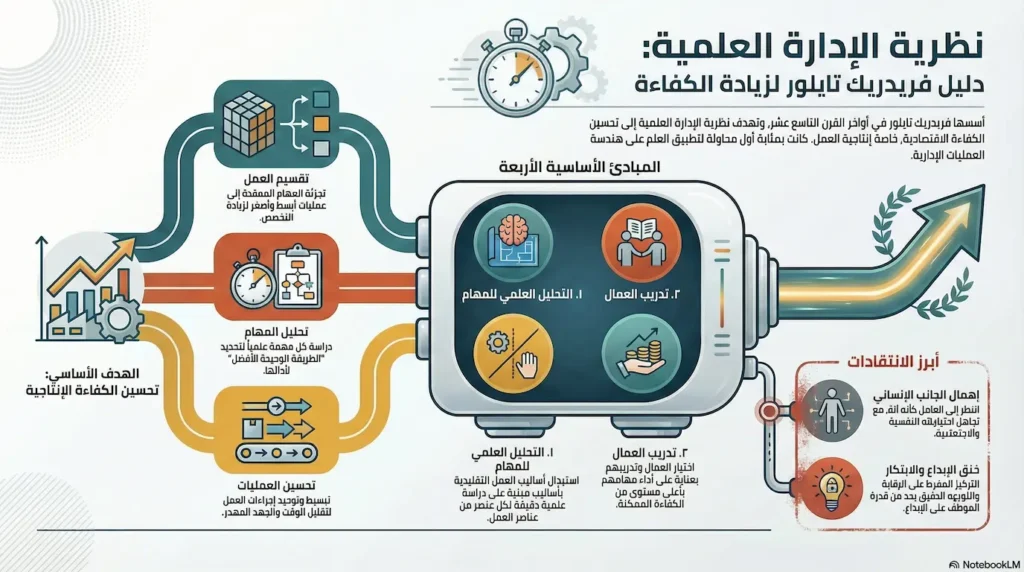
Taylor’s Scientific Management Theory is one of the most important theories that shaped modern management thought, establishing management as a science that can be studied and applied to increase productivity and improve performance.
Taylor came during a period when factories faced organizational chaos and decreased efficiency, so through his scientific studies, he attempted to transform management from merely professional experience into a scientific system based on precise laws and principles.
Taylor’s ideas caused a real revolution in industry and management, shifting the focus from the physical effort of workers to the scientific analysis of work methods, which later paved the way for the emergence of modern management schools such as Classical Management and Total Quality Management.
Who Is Frederick Taylor?
Frederick Winslow Taylor was born in 1856 in Philadelphia, United States, and initially worked as a mechanic in a factory before transitioning to become an industrial engineer and management researcher.
Through his long practical experience in production lines, Taylor noticed that most workers performed their tasks randomly, and that management did not rely on scientific foundations for planning and organizing work.
Professional and Academic Career
Taylor began his career at Midvale Steel Company, where he noticed that performance was low due to the lack of system. He began to study every movement made by workers, later developing what became known as Time and Motion Study.
Through these studies, he introduced the concept of “the best way to perform work” by analyzing steps and determining the most efficient method for execution.
The Industrial Environment in His Era
In the late 19th century, the Industrial Revolution was at its peak, and factories relied on human labor without scientific organizational methods.
This stage suffered from weak supervision, decreased productivity, and high rates of waste in time and effort.
Taylor came with a new vision that relied on scientific work analysis and motivating workers based on performance, not just seniority or experience.
His Most Notable Intellectual Achievements
Taylor published his famous book “The Principles of Scientific Management” in 1911, in which he laid the foundations that changed management thinking worldwide.
He also contributed to developing the concept of financial incentives for performance, which became the basis for incentive systems in contemporary companies.
The Emergence of Scientific Management Theory
ScientificManagementTheory emerged as a reaction to the organizational and production problems that factories faced in the early 20th century.
Taylor observed that traditional management methods relied on personal experience and intuitive estimates, leading to variation in performance among workers.
He believed that the solution lay in transforming management into a science based on study, observation, and precise measurement.
Economic and Social Conditions
That period witnessed enormous industrial expansion in America and Europe, creating an urgent need for new organizational methods that would ensure increased production and reduced costs.
Unskilled labor lacked scientific supervision, and management relied on personal authority, leading to poor distribution of effort and resources.
Problems of Work Before Taylor
-
Lack of clear performance standards.
-
Slow task completion due to reliance on traditional methods.
-
Conflicts between workers and management over wages and production.
-
Weak supervision and unclear responsibilities.
Motivation for Developing a Scientific Management System
Based on these problems, Taylor sought to find a precise scientific method for analyzing work and determining tasks and the optimal time for each operation.
His main goal was to achieve maximum production with minimum effort possible by organizing work, training workers scientifically, and motivating them based on actual performance.