










books

Understanding Skinner’s Operant Conditioning Theory Explained

29 April 2026
Views (7 views)
Understanding Skinner’s Operant Conditioning Theory Explained

Operant Conditioning Theory, developed by American psychologist B.F. Skinner, is one of the most important theories that contributed to the development of modern behaviorism and in explaining the mechanism of human learning and behavior.
Skinner presented a new concept that differs from Pavlov’s classical concept, as behavior is no longer just a response to a specific stimulus, but has become a result of the individual’s interaction with the consequences of their actions in the environment.
In other words, humans learn not only through stimuli presented to them, but also through the consequences of their behavior—whether they are rewards or punishments.

Skinner’s theory revolutionized the understanding of learning, as it became widely used in education, behavior modification, professional training, and even in the development of electronic educational systems.


Who Was B.F. Skinner?

B.F. Skinner was born in 1904 in Pennsylvania, United States, and studied English literature before later turning to experimental psychology at Harvard University.
Skinner was influenced by the works of behaviorists such as John Watson and Ivan Pavlov, but he developed their vision to be more comprehensive, focusing on the consequences of behavior rather than just stimuli.

His Scientific and Intellectual Life

Skinner dedicated his life to researching human and animal behavior through precise laboratory experiments.
His most famous work was in the field of operant conditioning, which he developed through a series of experiments in which he later used what became known as the ‘Skinner box’ to study how rewards and punishments affect behavior.
Skinner wrote several influential works in psychological thought, such as“Science and Human Behavior”and *”Walden Two”*, in which he presented his vision of an ideal society based on behavioral principles in organizing daily life.

His Scientific Method

Skinner believed that psychology should focus on observable and measurable behavior, not on invisible mental processes such as thinking or feelings.
Thus, he completed the path of behaviorism but gave it a precise experimental dimension by analyzing the relationship between behavior and its consequences.


The Concept of Operant Conditioning

Operant conditioning is a type oflearningthat occurs when an individual’s behavior is modified based on the consequences that follow it.
Thus, if the outcome of the behavior is positive, the likelihood of its repetition in the future increases, whereas if the outcome is negative or unsatisfactory, its repetition decreases or disappears.

In other words, operant behavior is behavior that ‘works’ on the environment to produce a specific outcome, and this outcome is what determines the continuation or extinction of the behavior.

The Difference Between Classical and Operant Conditioning

Operant conditioning differs from classical conditioning discovered by Pavlov.
In classical conditioning, learning occurs through the association between two stimuli (such as a bell and food), whereas in operant conditioning, learning happens through linking behavior to its consequences (such as receiving a reward after doing a good job).

In Pavlov’s model, the organism is passive, receiving the stimulus and responding to it, while in Skinner’s model, it is active, performing the behavior and testing its outcomes.

The Idea of ‘behavior as a Result of Reinforcement or Punishment’

Skinner believed that all behaviors — whether simple or complex — can be explained through reinforcement or punishment.
Therefore, society, education, and work are all systems based on these principles:

  • Positive behavior is reinforced, increasing its occurrence.

  • Negative behavior is punished or ignored, gradually disappearing.

With this concept, humans become continuously learning organisms shaped by environmental outcomes that nurture and form their behavior.
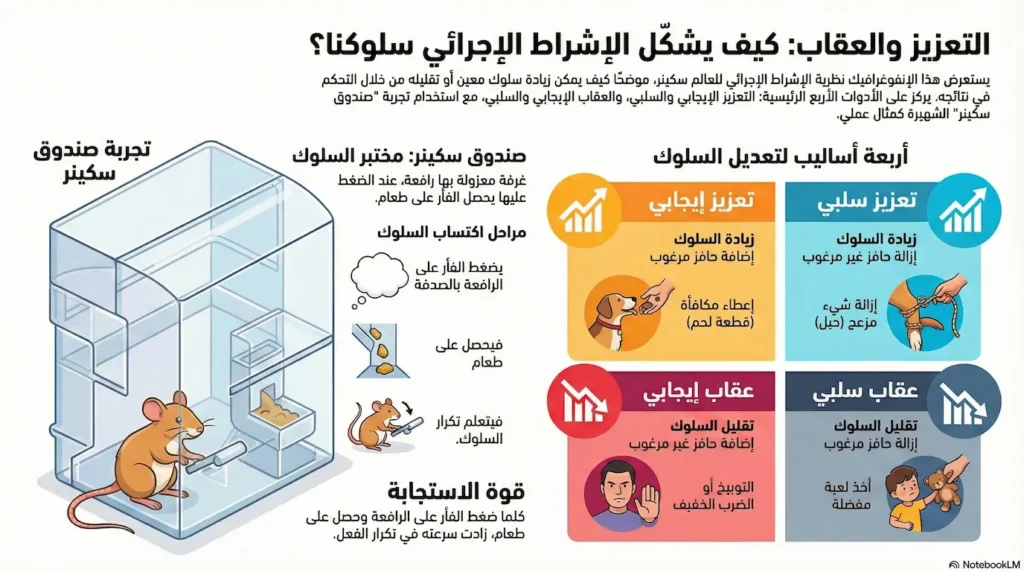



Skinner’s Experiments (skinner Box)

The Skinner Box is considered one of the most important innovations in the history ofexperimental psychologyand is the tool that Skinner used to study the relationship between behavior and outcomes in a precise scientific manner.
The purpose of these experiments was to understand how a living organism learns from the results of its actions, whether they were a reward or a punishment.

Description of the Basic Experiment

Skinner placed a mouse inside a closed box containing a small lever. Every time the mouse pressed the lever, a piece of food would drop as a reward.
Over time, the mouse learned that pressing the lever led to getting food, so it began to repeat this behavior frequently — and this is the essence of “operant conditioning”.

In other experiments, Skinner used pigeons to teach them to peck a specific key to get grains, which proved that behavior can be gradually shaped through positive reinforcement.

The Relationship Between Behavior, Response, and Outcome

Through these experiments, Skinner observed that behavior does not occur randomly, but is influenced by the results that follow it:

  • If a behavior is followed by a desirable outcome (such as food or praise), the likelihood of its repetition increases.

  • And if a behavior is followed by an undesirable outcome (such as punishment or deprivation), the likelihood of its repetition decreases.

What Does “operant Response” Mean?

Operant response is the behavior that acts on the environment to bring about change and obtain a result.
This means that the individual “performs” a behavior intentionally to influence their surroundings.
For example, the student who studies hard to get high grades, or the child who smiles to earn their parents’ approval — both exhibit operant behavior resulting from the expectation of a positive outcome.


Principles of Operant Conditioning Theory

Skinner interpretedlearningand behavior based on a set of fundamental principles that explain how behavior is acquired or modified based on its consequences.

Reinforcement Principle

Reinforcement is considered the most important principle in Skinner’s theory, referring to any action that increases the likelihood of repeating a desired behavior.
Reinforcement can be positive (giving a reward after the behavior) or negative (removing something unpleasant after the behavior).
For example, when a teacher praises a student for a correct answer, it reinforces the behavior and makes it more likely to be repeated in the future.

Punishment Principle

Punishment is an action used to decrease the likelihood of repeating an undesired behavior.
Punishment can be positive (adding something unpleasant, such as scolding) or negative (depriving the individual of something desired, such as preventing them from playing).
However, Skinner warned against excessive use of punishment as it may lead to fear or aggression rather than effective learning.

Extinction Principle

Extinction is the fading of behavior when the reinforcement that was supporting it stops.
When a teacher stops rewarding a student for participation, the student’s desire to participate gradually decreases.
This principle is used to modify undesired behavior by ignoring it and not reinforcing it.

Shaping Principle

Shaping is considered one of Skinner’s most precise and creative principles.
It refers to gradually shaping complex behavior by reinforcing the small steps that lead to it.
For example, a child can be trained to pronounce a new word by rewarding each successful attempt until they achieve the complete correct pronunciation.

Discrimination and Generalization Principle

  • Discrimination: is the individual’s ability to distinguish between different situations, showing behavior only in the appropriate situation.
    Example: A student who talks in the schoolyard but remains silent in the classroom.

  • Generalization: is applying learned behavior to similar situations.
    Example: A child who learned to say “thank you” at home begins to use it at school as well.


Types of Reinforcement and Punishment in Skinner’s Theory

Skinner divided reinforcement and punishment into two main types for each, to clarify how outcomes affect human behavior.

Positive Reinforcement

It is the presentation of a reward after a desired behavior to increase the likelihood of its recurrence.
For example: Giving a student a certificate of appreciation after succeeding in an exam.
This type is considered the most used in education and upbringing because it encourages learning in a positive way.

Negative Reinforcement

It is the removal of an aversive stimulus after a good behavior.
For example: Exempting a student from additional homework when they show improvement in their academic behavior.
That is, the desired behavior is rewarded by removing the annoying thing, which motivates the learner to repeat the behavior.


Positive Punishment

It is the addition of an aversive stimulus after an undesired behavior to reduce its occurrence.
For example: Scolding a student when they talk during class.
But Skinner emphasized the need to use this type with caution, as its results may lead to tension or resistance.


Negative Punishment

It is the removal of a desired stimulus after an undesired behavior.
For example: Depriving a child of watching TV due to wrong behavior.
This method is widely used in behavior modification because it teaches the individual that negative actions lead to the loss of privileges.


Practical Examples of Types of Reinforcement and Punishment

  1. In education: Using points and rewards to motivate students to comply.

  2. In child-rearing: Encouraging positive behavior with praise and disciplined ignoring of negative behavior.

  3. In the workplace: Providing financial rewards to high-performing employees, or withdrawing them when performance declines.


نظرية الاشتراط الإجرائي لسكنر


Comparison Between Pavlov and Skinner

Despite both Ivan Pavlov and Burrhus Frederick Skinner belonging to the behaviorist school, each presented a different model in explaining learning and human behavior.
While Pavlov focused on the relationship between stimulus and response, Skinner focused on the relationship between behavior and its consequence.

The Basic Differences Between Classical and Operant Conditioning

المقارنة الاشتراط الكلاسيكي (بافلوف) الاشتراط الإجرائي (سكنر)
الهدف ربط مثير محايد بمثير طبيعي ربط السلوك بنتيجته
نوع السلوك استجابي لا إرادي (مثل اللعاب) إرادي مقصود (مثل الضغط على زر أو الإجابة)
العنصر الأساسي في التعلم المثير (Stimulus) النتيجة أو التعزيز (Consequence)
دور الكائن الحي سلبي، يستجيب فقط للمثيرات نشط، يبادر بالسلوك ويختبر نتائجه
طريقة التعلم عن طريق الاقتران بين المثيرات عن طريق المكافأة أو العقاب بعد السلوك
أهم التجارب تجربة جرس بافلوف مع الكلب تجربة صندوق سكنر مع الفأر والحمام

Through this table, it becomes clear that Skinner developed the concept of learning to include voluntary behavior that can be directed or modified through outcomes, not just innate or reflexive behavior.


Educational Applications of Skinner’s Theory

Operant conditioning theory has had a significant impact on educational psychology and modern teaching methods, providing a practical model for how to enhance positive behavior and motivate learners within the classroom.

Using Reinforcement in Education

One of the most important educational applications is the use of positive reinforcement to motivate students to learn.
A teacher who rewards students with praise, good grades, or small prizes reinforces the desired behavior in them and encourages them to continue making an effort.
This reinforcement is not limited to material rewards, but also includes verbal encouragement and positive attention.

Positive Behavior Modification in Schools

Skinner’s principles are used to implement behavior modification programs within the school environment, such as:

  • Reinforcing good behaviors (such as commitment and respect).

  • Ignoring or reducing negative behaviors (such as disruption or interruption).

  • Using balanced educational punishment when needed, but within humane limits.

These programs have proven successful in improving the educational climate and increasing student participation in classroom activities.

Educational Punishment Strategies

Skinner believed that punishment could be beneficial if used moderately and with the aim of education rather than harm.
Punishment should be immediate and clear, and it is preferable to be followed by reinforcement for the correct behavior so that the learner learns what the required action is.

Programmed Learning

One of Skinner’s most important contributions to education was his development of what is known as Programmed Learning, which is a method that relies on dividing educational material into small steps, with immediate reinforcement provided after each correct answer.
This principle is considered the foundation upon which the idea of modern e-learning and self-learning is built.


Applications in Human Behavior Modification

Skinner’s theory is one of the most widely used theories in behavior modification and behavioral therapy programs, whether with children, adolescents, or even adults, as these programs are based on the principle that behavior can be changed through organized reinforcement or studied punishment.

The Role of Operant Conditioning in Behavioral Therapy

In behavioral therapy, positive reinforcement is used to strengthen desired behaviors (such as communication or commitment to therapy), while extinction or moderate punishment is used to eliminate unwanted behaviors (such as aggression or social withdrawal).
These methods have proven to be highly effective in treating disorders such as autism, anxiety disorders, and addiction.

Removing Unwanted Behaviors

The extinction principle is applied by ignoring negative behavior and not reinforcing it.
When the child notices that their aggressive behavior does not attract attention, they gradually reduce this behavior.
Strategies such as “differential reinforcement” are also used to reinforce acceptable behaviors instead of unwanted ones.

Reinforcing Positive Behaviors

Skinner focuses on praise, recognition, and symbolic rewards as effective tools for establishing positive behavior.
For example, in a work environment, recognizing an employee’s achievements increases their motivation to produce, while at home, praise encourages a child to behave well without the need for punishment.

Using Technology in Behavior Modification

In the modern era, Skinner’s principles have been employed in advanced digital applications such as habit modification programs and self-training through smartphones, where users receive immediate reinforcement after achieving a goal (such as exercising or quitting smoking).
This represents a digital extension of Skinner’s idea of “immediate reinforcement” which has proven effective in establishing positive behavior.


من نحن – دراسة الأفكار للبحث والتطوير


Criticisms of Skinner’s Theory

Although Skinner’s operant conditioning theory is considered one of the most influential theories in psychology and human behavior, it has not been without criticism. It has faced scientific and intellectual observations regarding its comprehensiveness of actual human behavior.

Focus on Observable Behavior and Neglect of Mental Processes

Many psychologists believe that Skinner reduced humans to their external behavior, ignoring internal mental aspects such as thinking, emotions, and motivations.
He did not care about what happens in the “mind” during the learning process, but focused only on what can be observed and measured.
While modern learning theories indicate that cognitive mental processes (such as attention, understanding, and memory) play a crucial role in learning.

The Stance on Human Will and Freedom

Skinner was criticized for considering humans as beings directed by the environment, and that their actions are not the result of free will but of previous consequences (reinforcement or punishment).
Some philosophers have argued that this view diminishes the importance of individual responsibility and free choice, and confines humans within a “behavioral control” circle.

Difficulty in Generalizing Results to All Human Behaviors

Most of Skinner’s experiments were on animals (rats and pigeons), and then were generalized to humans.
Critics have pointed out that human behavior is more complex and diverse, influenced by social and cultural factors that cannot be replicated in the laboratory.
Therefore, the theory explains some aspects of behavior, but not all of them.

Over-reliance on Reinforcement and Punishment

Despite the effectiveness of reinforcement in changing behavior, over-reliance on it may lead to the individual becoming attached to external rewards rather than intrinsic motivation.
This is what made some educators call for integrating Skinner’s principles with theories of intrinsic motivation that encourage learning out of personal motivation rather than just fear or desire for reward.


The Impact of Skinner’s Theory on Modern Psychology

Despite the previous criticisms, Skinner’s theory has left a deep and lasting mark in the fields of education, applied psychology, and behavior modification.

Its Influence on the Emergence of Applied Behavior Analysis (ABA)

Applied Behavior Analysis (ABA) is considered one of the most important applications of Skinner’s theory in the modern era.
This approach is widely used in treating disorders such as autism, attention deficit hyperactivity disorder (ADHD).
Where therapists rely on the principles of positive reinforcement to strengthen appropriate behaviors and reduce undesirable ones.

Its Use in Education and Vocational Training

Programmed instruction and reinforcement-based learning are considered direct applications of Skinner’s thought.
Modern training systems have benefited from these principles in designing electronic curricula and gamification that provide immediate rewards to learners.
Operant conditioning principles are also used in developing performance management systems in workplace environments.

Its Relationship With Modern Learning Theories

Skinner’s theory forms the foundation on which many contemporary learning theories are built, such as:

  1. Cognitive Behavioral Therapy (CBT) which combines thinking and behavior.

  2. Self-Regulated Learning which benefits from the idea of internal reinforcement.

  3. E-Learning which relies on the principle of immediate feedback derived from Skinner’s philosophy.

It can be said that Skinner did not eliminate the role of humans, but rather established a scientific basis for understanding how behavior is built and organized through the environment.


Conclusion

Skinner’s theory of operant conditioning brought about a radical transformation in psychology, providing a clear scientific explanation for how behavior is acquired and modified through reinforcement and punishment.
Skinner shifted psychological thinking from the stage of theoretical speculation to the stage of experimental analysis of behavior, which made it one of the most applicable theories in education, management, and behavioral therapy.

Despite the criticisms it has faced, its principles remain standing and used to this day, especially in fields that require changing or enhancing behavior in systematic and studied ways.
It is a theory that reminds us that learning is a continuous process built through experience, and that the environment is the greatest laboratory that shapes human behavior throughout life.


Frequently Asked Questions (faqs)

1. What is the difference between operant conditioning and classical conditioning?
In classical conditioning, an individual learns by associating two stimuli, while in operant conditioning, they learn through the consequences of their behavior (such as reward or punishment).


2. What is meant by positive reinforcement in Skinner’s theory?
It involves providing a reward or pleasant outcome after good behavior to increase the likelihood of its repetition, such as praising a student or giving them a reward after good performance.


3. What are the main applications of operant conditioning in education?
Skinner’s principles are used in designing educational curricula, programmed instruction, e-learning, and behavior modification programs within schools.


4. What are the criticisms directed at Skinner’s theory?
The theory focuses on observable behavior while ignoring mental aspects, underestimates human willpower, and relies heavily on external reinforcement and punishment.


5. Is Skinner’s theory still applicable today?
Yes, but in an evolved form. Its principles are now used in areas like smart education, behavioral training, and applied behavior analysis, while being integrated with modern cognitive and human elements.

Comments

books

Understanding Skinner’s Operant Conditioning Theory Explained

29 April 2026
Views (8 views)
Understanding Skinner’s Operant Conditioning Theory Explained

Operant Conditioning Theory, developed by American psychologist B.F. Skinner, is one of the most important theories that contributed to the development of modern behaviorism and in explaining the mechanism of human learning and behavior.
Skinner presented a new concept that differs from Pavlov’s classical concept, as behavior is no longer just a response to a specific stimulus, but has become a result of the individual’s interaction with the consequences of their actions in the environment.
In other words, humans learn not only through stimuli presented to them, but also through the consequences of their behavior—whether they are rewards or punishments.

Skinner’s theory revolutionized the understanding of learning, as it became widely used in education, behavior modification, professional training, and even in the development of electronic educational systems.


Who Was B.F. Skinner?

B.F. Skinner was born in 1904 in Pennsylvania, United States, and studied English literature before later turning to experimental psychology at Harvard University.
Skinner was influenced by the works of behaviorists such as John Watson and Ivan Pavlov, but he developed their vision to be more comprehensive, focusing on the consequences of behavior rather than just stimuli.

His Scientific and Intellectual Life

Skinner dedicated his life to researching human and animal behavior through precise laboratory experiments.
His most famous work was in the field of operant conditioning, which he developed through a series of experiments in which he later used what became known as the ‘Skinner box’ to study how rewards and punishments affect behavior.
Skinner wrote several influential works in psychological thought, such as“Science and Human Behavior”and *”Walden Two”*, in which he presented his vision of an ideal society based on behavioral principles in organizing daily life.

His Scientific Method

Skinner believed that psychology should focus on observable and measurable behavior, not on invisible mental processes such as thinking or feelings.
Thus, he completed the path of behaviorism but gave it a precise experimental dimension by analyzing the relationship between behavior and its consequences.


The Concept of Operant Conditioning

Operant conditioning is a type oflearningthat occurs when an individual’s behavior is modified based on the consequences that follow it.
Thus, if the outcome of the behavior is positive, the likelihood of its repetition in the future increases, whereas if the outcome is negative or unsatisfactory, its repetition decreases or disappears.

In other words, operant behavior is behavior that ‘works’ on the environment to produce a specific outcome, and this outcome is what determines the continuation or extinction of the behavior.

The Difference Between Classical and Operant Conditioning

Operant conditioning differs from classical conditioning discovered by Pavlov.
In classical conditioning, learning occurs through the association between two stimuli (such as a bell and food), whereas in operant conditioning, learning happens through linking behavior to its consequences (such as receiving a reward after doing a good job).

In Pavlov’s model, the organism is passive, receiving the stimulus and responding to it, while in Skinner’s model, it is active, performing the behavior and testing its outcomes.

The Idea of ‘behavior as a Result of Reinforcement or Punishment’

Skinner believed that all behaviors — whether simple or complex — can be explained through reinforcement or punishment.
Therefore, society, education, and work are all systems based on these principles:

  • Positive behavior is reinforced, increasing its occurrence.

  • Negative behavior is punished or ignored, gradually disappearing.

With this concept, humans become continuously learning organisms shaped by environmental outcomes that nurture and form their behavior.



Skinner’s Experiments (skinner Box)

The Skinner Box is considered one of the most important innovations in the history ofexperimental psychologyand is the tool that Skinner used to study the relationship between behavior and outcomes in a precise scientific manner.
The purpose of these experiments was to understand how a living organism learns from the results of its actions, whether they were a reward or a punishment.

Description of the Basic Experiment

Skinner placed a mouse inside a closed box containing a small lever. Every time the mouse pressed the lever, a piece of food would drop as a reward.
Over time, the mouse learned that pressing the lever led to getting food, so it began to repeat this behavior frequently — and this is the essence of “operant conditioning”.

In other experiments, Skinner used pigeons to teach them to peck a specific key to get grains, which proved that behavior can be gradually shaped through positive reinforcement.

The Relationship Between Behavior, Response, and Outcome

Through these experiments, Skinner observed that behavior does not occur randomly, but is influenced by the results that follow it:

  • If a behavior is followed by a desirable outcome (such as food or praise), the likelihood of its repetition increases.

  • And if a behavior is followed by an undesirable outcome (such as punishment or deprivation), the likelihood of its repetition decreases.

What Does “operant Response” Mean?

Operant response is the behavior that acts on the environment to bring about change and obtain a result.
This means that the individual “performs” a behavior intentionally to influence their surroundings.
For example, the student who studies hard to get high grades, or the child who smiles to earn their parents’ approval — both exhibit operant behavior resulting from the expectation of a positive outcome.


Principles of Operant Conditioning Theory

Skinner interpretedlearningand behavior based on a set of fundamental principles that explain how behavior is acquired or modified based on its consequences.

Reinforcement Principle

Reinforcement is considered the most important principle in Skinner’s theory, referring to any action that increases the likelihood of repeating a desired behavior.
Reinforcement can be positive (giving a reward after the behavior) or negative (removing something unpleasant after the behavior).
For example, when a teacher praises a student for a correct answer, it reinforces the behavior and makes it more likely to be repeated in the future.

Punishment Principle

Punishment is an action used to decrease the likelihood of repeating an undesired behavior.
Punishment can be positive (adding something unpleasant, such as scolding) or negative (depriving the individual of something desired, such as preventing them from playing).
However, Skinner warned against excessive use of punishment as it may lead to fear or aggression rather than effective learning.

Extinction Principle

Extinction is the fading of behavior when the reinforcement that was supporting it stops.
When a teacher stops rewarding a student for participation, the student’s desire to participate gradually decreases.
This principle is used to modify undesired behavior by ignoring it and not reinforcing it.

Shaping Principle

Shaping is considered one of Skinner’s most precise and creative principles.
It refers to gradually shaping complex behavior by reinforcing the small steps that lead to it.
For example, a child can be trained to pronounce a new word by rewarding each successful attempt until they achieve the complete correct pronunciation.

Discrimination and Generalization Principle

  • Discrimination: is the individual’s ability to distinguish between different situations, showing behavior only in the appropriate situation.
    Example: A student who talks in the schoolyard but remains silent in the classroom.

  • Generalization: is applying learned behavior to similar situations.
    Example: A child who learned to say “thank you” at home begins to use it at school as well.


Types of Reinforcement and Punishment in Skinner’s Theory

Skinner divided reinforcement and punishment into two main types for each, to clarify how outcomes affect human behavior.

Positive Reinforcement

It is the presentation of a reward after a desired behavior to increase the likelihood of its recurrence.
For example: Giving a student a certificate of appreciation after succeeding in an exam.
This type is considered the most used in education and upbringing because it encourages learning in a positive way.

Negative Reinforcement

It is the removal of an aversive stimulus after a good behavior.
For example: Exempting a student from additional homework when they show improvement in their academic behavior.
That is, the desired behavior is rewarded by removing the annoying thing, which motivates the learner to repeat the behavior.


Positive Punishment

It is the addition of an aversive stimulus after an undesired behavior to reduce its occurrence.
For example: Scolding a student when they talk during class.
But Skinner emphasized the need to use this type with caution, as its results may lead to tension or resistance.


Negative Punishment

It is the removal of a desired stimulus after an undesired behavior.
For example: Depriving a child of watching TV due to wrong behavior.
This method is widely used in behavior modification because it teaches the individual that negative actions lead to the loss of privileges.


Practical Examples of Types of Reinforcement and Punishment

  1. In education: Using points and rewards to motivate students to comply.

  2. In child-rearing: Encouraging positive behavior with praise and disciplined ignoring of negative behavior.

  3. In the workplace: Providing financial rewards to high-performing employees, or withdrawing them when performance declines.


نظرية الاشتراط الإجرائي لسكنر


Comparison Between Pavlov and Skinner

Despite both Ivan Pavlov and Burrhus Frederick Skinner belonging to the behaviorist school, each presented a different model in explaining learning and human behavior.
While Pavlov focused on the relationship between stimulus and response, Skinner focused on the relationship between behavior and its consequence.

The Basic Differences Between Classical and Operant Conditioning

المقارنة الاشتراط الكلاسيكي (بافلوف) الاشتراط الإجرائي (سكنر)
الهدف ربط مثير محايد بمثير طبيعي ربط السلوك بنتيجته
نوع السلوك استجابي لا إرادي (مثل اللعاب) إرادي مقصود (مثل الضغط على زر أو الإجابة)
العنصر الأساسي في التعلم المثير (Stimulus) النتيجة أو التعزيز (Consequence)
دور الكائن الحي سلبي، يستجيب فقط للمثيرات نشط، يبادر بالسلوك ويختبر نتائجه
طريقة التعلم عن طريق الاقتران بين المثيرات عن طريق المكافأة أو العقاب بعد السلوك
أهم التجارب تجربة جرس بافلوف مع الكلب تجربة صندوق سكنر مع الفأر والحمام

Through this table, it becomes clear that Skinner developed the concept of learning to include voluntary behavior that can be directed or modified through outcomes, not just innate or reflexive behavior.


Educational Applications of Skinner’s Theory

Operant conditioning theory has had a significant impact on educational psychology and modern teaching methods, providing a practical model for how to enhance positive behavior and motivate learners within the classroom.

Using Reinforcement in Education

One of the most important educational applications is the use of positive reinforcement to motivate students to learn.
A teacher who rewards students with praise, good grades, or small prizes reinforces the desired behavior in them and encourages them to continue making an effort.
This reinforcement is not limited to material rewards, but also includes verbal encouragement and positive attention.

Positive Behavior Modification in Schools

Skinner’s principles are used to implement behavior modification programs within the school environment, such as:

  • Reinforcing good behaviors (such as commitment and respect).

  • Ignoring or reducing negative behaviors (such as disruption or interruption).

  • Using balanced educational punishment when needed, but within humane limits.

These programs have proven successful in improving the educational climate and increasing student participation in classroom activities.

Educational Punishment Strategies

Skinner believed that punishment could be beneficial if used moderately and with the aim of education rather than harm.
Punishment should be immediate and clear, and it is preferable to be followed by reinforcement for the correct behavior so that the learner learns what the required action is.

Programmed Learning

One of Skinner’s most important contributions to education was his development of what is known as Programmed Learning, which is a method that relies on dividing educational material into small steps, with immediate reinforcement provided after each correct answer.
This principle is considered the foundation upon which the idea of modern e-learning and self-learning is built.


Applications in Human Behavior Modification

Skinner’s theory is one of the most widely used theories in behavior modification and behavioral therapy programs, whether with children, adolescents, or even adults, as these programs are based on the principle that behavior can be changed through organized reinforcement or studied punishment.

The Role of Operant Conditioning in Behavioral Therapy

In behavioral therapy, positive reinforcement is used to strengthen desired behaviors (such as communication or commitment to therapy), while extinction or moderate punishment is used to eliminate unwanted behaviors (such as aggression or social withdrawal).
These methods have proven to be highly effective in treating disorders such as autism, anxiety disorders, and addiction.

Removing Unwanted Behaviors

The extinction principle is applied by ignoring negative behavior and not reinforcing it.
When the child notices that their aggressive behavior does not attract attention, they gradually reduce this behavior.
Strategies such as “differential reinforcement” are also used to reinforce acceptable behaviors instead of unwanted ones.

Reinforcing Positive Behaviors

Skinner focuses on praise, recognition, and symbolic rewards as effective tools for establishing positive behavior.
For example, in a work environment, recognizing an employee’s achievements increases their motivation to produce, while at home, praise encourages a child to behave well without the need for punishment.

Using Technology in Behavior Modification

In the modern era, Skinner’s principles have been employed in advanced digital applications such as habit modification programs and self-training through smartphones, where users receive immediate reinforcement after achieving a goal (such as exercising or quitting smoking).
This represents a digital extension of Skinner’s idea of “immediate reinforcement” which has proven effective in establishing positive behavior.


من نحن – دراسة الأفكار للبحث والتطوير


Criticisms of Skinner’s Theory

Although Skinner’s operant conditioning theory is considered one of the most influential theories in psychology and human behavior, it has not been without criticism. It has faced scientific and intellectual observations regarding its comprehensiveness of actual human behavior.

Focus on Observable Behavior and Neglect of Mental Processes

Many psychologists believe that Skinner reduced humans to their external behavior, ignoring internal mental aspects such as thinking, emotions, and motivations.
He did not care about what happens in the “mind” during the learning process, but focused only on what can be observed and measured.
While modern learning theories indicate that cognitive mental processes (such as attention, understanding, and memory) play a crucial role in learning.

The Stance on Human Will and Freedom

Skinner was criticized for considering humans as beings directed by the environment, and that their actions are not the result of free will but of previous consequences (reinforcement or punishment).
Some philosophers have argued that this view diminishes the importance of individual responsibility and free choice, and confines humans within a “behavioral control” circle.

Difficulty in Generalizing Results to All Human Behaviors

Most of Skinner’s experiments were on animals (rats and pigeons), and then were generalized to humans.
Critics have pointed out that human behavior is more complex and diverse, influenced by social and cultural factors that cannot be replicated in the laboratory.
Therefore, the theory explains some aspects of behavior, but not all of them.

Over-reliance on Reinforcement and Punishment

Despite the effectiveness of reinforcement in changing behavior, over-reliance on it may lead to the individual becoming attached to external rewards rather than intrinsic motivation.
This is what made some educators call for integrating Skinner’s principles with theories of intrinsic motivation that encourage learning out of personal motivation rather than just fear or desire for reward.


The Impact of Skinner’s Theory on Modern Psychology

Despite the previous criticisms, Skinner’s theory has left a deep and lasting mark in the fields of education, applied psychology, and behavior modification.

Its Influence on the Emergence of Applied Behavior Analysis (ABA)

Applied Behavior Analysis (ABA) is considered one of the most important applications of Skinner’s theory in the modern era.
This approach is widely used in treating disorders such as autism, attention deficit hyperactivity disorder (ADHD).
Where therapists rely on the principles of positive reinforcement to strengthen appropriate behaviors and reduce undesirable ones.

Its Use in Education and Vocational Training

Programmed instruction and reinforcement-based learning are considered direct applications of Skinner’s thought.
Modern training systems have benefited from these principles in designing electronic curricula and gamification that provide immediate rewards to learners.
Operant conditioning principles are also used in developing performance management systems in workplace environments.

Its Relationship With Modern Learning Theories

Skinner’s theory forms the foundation on which many contemporary learning theories are built, such as:

  1. Cognitive Behavioral Therapy (CBT) which combines thinking and behavior.

  2. Self-Regulated Learning which benefits from the idea of internal reinforcement.

  3. E-Learning which relies on the principle of immediate feedback derived from Skinner’s philosophy.

It can be said that Skinner did not eliminate the role of humans, but rather established a scientific basis for understanding how behavior is built and organized through the environment.


Conclusion

Skinner’s theory of operant conditioning brought about a radical transformation in psychology, providing a clear scientific explanation for how behavior is acquired and modified through reinforcement and punishment.
Skinner shifted psychological thinking from the stage of theoretical speculation to the stage of experimental analysis of behavior, which made it one of the most applicable theories in education, management, and behavioral therapy.

Despite the criticisms it has faced, its principles remain standing and used to this day, especially in fields that require changing or enhancing behavior in systematic and studied ways.
It is a theory that reminds us that learning is a continuous process built through experience, and that the environment is the greatest laboratory that shapes human behavior throughout life.


Frequently Asked Questions (faqs)

1. What is the difference between operant conditioning and classical conditioning?
In classical conditioning, an individual learns by associating two stimuli, while in operant conditioning, they learn through the consequences of their behavior (such as reward or punishment).


2. What is meant by positive reinforcement in Skinner’s theory?
It involves providing a reward or pleasant outcome after good behavior to increase the likelihood of its repetition, such as praising a student or giving them a reward after good performance.


3. What are the main applications of operant conditioning in education?
Skinner’s principles are used in designing educational curricula, programmed instruction, e-learning, and behavior modification programs within schools.


4. What are the criticisms directed at Skinner’s theory?
The theory focuses on observable behavior while ignoring mental aspects, underestimates human willpower, and relies heavily on external reinforcement and punishment.


5. Is Skinner’s theory still applicable today?
Yes, but in an evolved form. Its principles are now used in areas like smart education, behavioral training, and applied behavior analysis, while being integrated with modern cognitive and human elements.

Comments

Explore Our Services
11111
Professional Jamovi Data Analysis Services for Students & Researchers
icon
Professional Jamovi Data Analysis Services for Students & Researchers
11111
خدمة تحليل البيانات باستخدام برنامج JASP
icon
خدمة تحليل البيانات باستخدام برنامج JASP
11111
خدمة التحليل الإحصائي النوعي
icon
خدمة التحليل الإحصائي النوعي
11111
خدمة التحليل المختلط بمنهجية Q
icon
خدمة التحليل المختلط بمنهجية Q
11111
خدمة التحليل الإحصائي بلغة R
icon
خدمة التحليل الإحصائي بلغة R
11111
خدمة التحليل الإحصائي ببرنامج E-Views
icon
خدمة التحليل الإحصائي ببرنامج E-Views
11111
خدمة التحليل الإحصائي المتقدم بـ AMOS
icon
خدمة التحليل الإحصائي المتقدم بـ AMOS
11111
خدمة تصور البيانات (Data Visualization) وإنشاء تقارير تفاعلية
icon
خدمة تصور البيانات (Data Visualization) وإنشاء تقارير تفاعلية
11111
خدمة تصميم العروض التقديمية للمناقشة
icon
خدمة تصميم العروض التقديمية للمناقشة
11111
خدمة الباحث المشارك (Co-Researcher Service)
icon
خدمة الباحث المشارك (Co-Researcher Service)
11111
خدمة عمل كتاب إلكتروني وفق المعايير الأكاديمية
icon
خدمة عمل كتاب إلكتروني وفق المعايير الأكاديمية
11111
خدمة كتابة ملخص البحث وترجمته للإنجليزية
icon
خدمة كتابة ملخص البحث وترجمته للإنجليزية
11111
خدمة تلخيص الكتب والمراجع العربية والإنجليزية
icon
خدمة تلخيص الكتب والمراجع العربية والإنجليزية
11111
خدمة تصميم البوسترات البحثية الاحترافية
icon
خدمة تصميم البوسترات البحثية الاحترافية
11111
خدمة ترشيح المجلات العلمية المحكمة
icon
خدمة ترشيح المجلات العلمية المحكمة