





Article Index
We select the best for you

4 AI Tools for Discovering Studies and Summarizing Research
14 April 2026
(2 views)
Most Viewed
Latest Articles
Categories
- Master’s and Doctoral Thesis Preparation
- Scientific Research Tools
- Universities News
- الإطار النظري
- التحليل الاحصائي والمناقشة
- الترجمة
- الخدمات اللغوية والأكاديمية
- الدراسات السابقة
- الفهرسة والتوثيق
- النظريات العلمية
- برامج الابتعاث
- خدمات السعودية
- خطة البحث
- دلائل الجامعات العربية
- قصص نجاح الباحثين
- مفاهيم هامة في البحث العلمي
- مناهج البحث

If you’re working on a master’s thesis or doctoral dissertation, you’ve likely experienced this scenario:
You open a scientific database, type in a keyword, and thousands of studies appear. You read the first abstract, then the second, then the third… and after an hour, you feel no closer to the answer you’re looking for.
Scientific research today faces a strange paradox:
Knowledge is more available than ever, but finding the right study has become harder.
This is where a new category of AI-powered tools has emerged. These tools don’t just search for scientific papers; they help you to:
-
Discover studies quickly
-
Summarize complex research
-
Map scientific literature
-
Understand the relationships between different studies
In this article, we’ll explore 4AI toolsthat help you: discover studies quickly, summarize research, and map scientific literature, with practical explanations of how to use them in academic work.
What Are AI Tools for Scientific Research?
AI tools for scientific researchare platforms that use machine learning algorithms and text analysis to help researchers quickly and efficiently analyze scientific literature.
Unlike traditional search engines like
Google Scholar,
these tools can:
-
Analyze thousands of research papers in seconds
-
Extract key ideas from studies
-
Discover relationships between different research papers
-
Suggest scientific papers related to your topic
When Do Researchers Use Them?
Typically in three main phases:
-
Research topic selection phase
-
Literature review phaseArticle writing and publication phaseThis is why these tools have become an important part of the modern research environment in fields like
-
Data Science
and
Information Science
.
Tool 1: Semantic ScholarThe platform
Semantic Scholar
is one of the most well-known AI-powered academic search engines.
Developed by the
Allen Institute for AI
it aims to help researchers quickly find the most influential studies.
What does it offer researchers?
1️⃣ Discover important studies
Instead of Showing Thousands of Unsorted Results, the Platform Identifies:
The Most Influential Papers
Studies related to your topic
-
The most cited research
-
2️⃣ Summarize key ideas
-
The tool extracts:
The Study’s Objective
The methodology
-
The main results
-
This saves hours of initial reading.
-
3️⃣ Citation network analysis
You can see:
Studies That Cited the Research
Studies that the research built upon
-
This helps you build a knowledge map of the topic.
-
Practical example
If you’re studying the topic:
The Impact of AI on Education
You can search for the keyword, then use:
Highly Influential Citations
Related Papers
-
to quickly find the foundational studies in the field.
-
Tool 2: Elicit
The tool
Elicit
is an intelligent assistant designed specifically for scientific literature review.
Developed by
Ought
.
Why do researchers love it?Because it works differently:
Instead of Searching Only With Keywords, You Can Ask a Research Question.
For example:
What are the effects of online learning on student engagement?
The tool then automatically:
Searches for studies related to the question
Summarizes the results
-
Extracts important data.
-
Its most important features
-
1️⃣ Extract data from research
It Can Build a Table Containing:
Sample Size
Methodology
-
Key results
-
2️⃣ Automatically summarize studies
-
It provides a clear summary for each study.
3️⃣ Support Literature Review Writing
You can quickly compare dozens of studies.
Tool 3: Research Rabbit
The tool
Research Rabbit
is sometimes described as the Spotify for scientific research.
The idea is simple but powerful.
Instead of traditional searching, you can:
Add a set of important papers
Then the tool automatically discovers similar papers.
-
Its most important uses
-
1️⃣ Discover related studies
The Tool Relies on Citation Network Analysis.
2️⃣ Follow Important Researchers
You can follow:
Specific Authors
Specific research fields
-
3️⃣ Build a research library
-
It helps you organize scientific papers visually.
Tool 4: Connected Papers
The tool
Connected Papers
focuses on an important aspect of scientific research: understanding the relationships between studies.
Instead of reading studies separately, the tool displays a visual map of the scientific literature.
What does it offer?
1️⃣ Map scientific literature
Each Study Appears as a Point in the Graph.
The Proximity Between Points Means the Studies Are Similar or Related.
2️⃣ Discover foundational studies
You can identify:
Classic Studies
Modern influential studies
-
3️⃣ Understand field evolution
-
It helps you see how the topic has evolved over time.
How to Use These Tools Step by Step?
Here’s a practical method used by many researchers:
Step 1: Start With a Foundational Scientific Paper
Find an important study in your field.
Step 2: Use Connected Papers
to create a map of the scientific literature.
Step 3: Use Research Rabbit
to discover similar studies.
Step 4: Use Elicit
to summarize and compare studies.
Step 5: Use Semantic Scholar
to analyze citations and identify the most influential research.
This Way You Can Build a Strong Literature Review in Much Less Time.
Common mistakes researchers make
Even with these tools, some researchers make repeated mistakes.
Mistake 1: Over-reliance on AI
The tools help with exploration but don’t replace critical reading.
Mistake 2: Ignoring Classic Studies
Some tools tend to show only recent studies.
Mistake 3: Using Very General Keywords
The more precise the keywords, the better the results.
Expert Tips for Maximum Benefit
If you want to use these tools effectively:
1️⃣ Always Start With a Foundational Study in the Field
Then expand from there.
2️⃣ Collect Studies in a Reference Manager
Like
Zotero
or
Mendeley
.
3️⃣ Focus on the most cited studiesAs they are often the most influential.
4️⃣ Don’t Rely Only on AI Summaries
Always read the original study.
The Academic Team
The academic team at
Idea Study
company consists of professors and researchers specializing in various fields of scientific research, who possess extensive academic and practical experience in supporting graduate students and helping them develop their research according to approved scientific standards.The academic team is characterized by:Specialized academic experience
in supervising master’s theses and doctoral dissertations in various disciplines.
-
Deep knowledge of scientific research standardsand university requirements in different Arab countries.
-
The ability to accurately analyze research topicsand connect them to the research problem and objectives systematically.
-
Providing professional scientific guidancethat helps researchers develop their ideas and formulate strong research plans.
-
Considering the specificity of each academic disciplinewhen providing research consultations and guidance.
-
Continuous follow-up with researchersto help them overcome challenges they may face during their studies.
-
Thanks to this scientific diversity and accumulated academic experience, the team works to provide a scientific support environment that helps researchers build solid research and achieve reliable scientific results.Academic Consultation Service
If you’re facing difficulties in preparing your scientific research or don’t know where to start, then the
Academic Consultation Service from Idea Study Company
provides you with comprehensive scientific support to help you overcome research challenges with confidence and professionalism. We rely on a team of academic professors specializing in various fields to provide precise scientific guidance that meets university requirements and scientific research standards.What do we offer you in the Academic Advisor service?Specialized academic guidance
To Help You Choose a Suitable and Innovative Research Topic That Aligns With Your Specialization and University Requirements.
-
Comprehensive methodological supportin all stages of scientific research, from defining the research problem and formulating objectives to preparing a research plan.
-
Analysis and review of previous studiesand helping you identify the research gap and build a strong theoretical framework for your study.
-
Guidance in choosing the appropriate research methodologyand data collection tools that suit the nature of the study.
-
Continuous follow-up with a specialized academic advisor in your field of studywho accompanies you step by step during thesis preparation.
-
Help in organizing ideas and building a clear scientific structure for the thesis or researchaccording to approved academic standards.
-
Providing scientific solutions to research problemsthat you may encounter while preparing your master’s thesis or doctoral dissertation.
-
Support available for all Arab universitiesRegardless of the university or country, while considering the requirements of each academic institution.
-
💡 With the Academic Advisor service from Idea Study company, you will havea specialized academic expert accompanying you throughout your research journey
to ensure building a strong and systematic scientific study.Request the service now and start your research journey with greater confidence.Conclusion
Researchers no longer need to spend weeks manually searching for studies.
Today, AI Tools Can Significantly Shorten This Process.
And in this article, we’ve seen 4 AI tools that help you: discover studies quickly, summarize research, and map scientific literature, which are:
Semantic Scholar
Elicit
-
ResearchRabbit
-
Connected Papers
-
Using these tools doesn’t mean replacing scientific thinking, but rather freeing up the researcher’s time to focus on analysis and innovation.
-
Frequently Asked Questions
What is the best tool for discovering scientific studies?
Semantic Scholar
And
ResearchRabbit
are among the best tools for discovering studies related to your research topic.
Can AI write a literature review?
It can help summarize and organize studies, but it doesn’t replace the critical analysis done by the researcher.
What is the best tool for mapping scientific literature?
The Tool
Connected Papers
Is One of the Most Popular Tools in This Field.
Are these tools free?
Most offer free versions with basic features, plus paid plans with advanced features.
About the Author
Dr. Jawaher Al-shahri Is an Assistant Professor in the Department of Statistics and Operations Research, Specializing in Mathematical Statistics and Applied Statistics, With a Research Interest in Developing Advanced Statistical Models and Data Analysis. Her Academic Work Focuses on Employing Modern Statistical Methods in Analyzing Complex Data and Developing Quantitative Methodologies That Support Scientific Research and Data-based Decision Making.
Dr. Al-Shahri is interested in developing statistical knowledge and its applications in various scientific fields, and seeks to enhance the use of data analysis and probabilistic models in supporting scientific research and improving the quality of academic studies.
First: Personal Information
Name: Dr. Jawaher Al-Shahri
Academic Degree: Assistant Professor
Department: Statistics and Operations Research
Specialization: Mathematical Statistics and Applied Statistics
Second: Academic Qualifications
PhD in Statistics
College of Science – North Carolina State University – United States.
Master’s in Applied Statistics
Faculty of Economics and Political Science – Cairo University – Arab Republic of Egypt.
Bachelor’s in Statistics
College of Science – King Saud University – Kingdom of Saudi Arabia.
Third: Research Interests
Her research interests include a range of advanced fields in statistics and data analysis, most notably:
Mathematical and theoretical statistics
Advanced Data Analysis
Probabilistic Models
- Statistical estimation and inference methods
- Applied statistics in science and engineering
- Big Data Analytics
- Fourth: Academic Experience
- Dr. Al-Shahri has academic and research experience in teaching and developing statistics courses at undergraduate and graduate levels, and her experience includes:
- Teaching mathematical statistics, applied statistics, and probability models.
Teaching data analysis and statistics using statistical software.
Supervising graduation projects and scientific theses in the field of statistics.
- Participating in developing study plans and academic programs in statistics and operations research.
- Contributing to academic quality committees and developing educational courses.
- Fifth: Statistical and Technical Skills
- Dr. Al-Shahri has advanced experience in data analysis and building statistical models using several specialized software and tools, including:
- R
SAS
SPSS
- MINITAB
- Mathematica
- Microsoft Excel (Advanced Statistical Analysis)
- She also has experience in:
- Advanced statistical modeling
- Multivariate data analysis
Time series analysis
- Experimental data analysis
- Sixth: Scientific Activities
- Dr. Al-Shahri has participated in many academic activities aimed at developing education and scientific research, including:
- Participating in specialized scientific seminars and conferences in statistics and data analysis.
Contributing to developing academic courses and programs in the field of statistics.
Publishing scientific research in applied statistics and data analysis.
- Providing training workshops on using statistical software in scientific research.
- Academic Vision
- Dr. Jawaher Al-Shahri seeks to develop the use of advanced statistical methods in scientific research and their applications in various specialties, which contributes to enhancing data analysis culture and evidence-based decision making. She is also interested in developing scientific content in Arabic in the fields of statistics and data analysis to support researchers and graduate students and enable them to employ statistical tools in their research efficiently.
- تقديم ورش تدريبية حول استخدام البرمجيات الإحصائية في البحث العلمي.
الرؤية الأكاديمية
تسعى د. جواهر الشهري إلى تطوير استخدام الأساليب الإحصائية المتقدمة في البحث العلمي وتطبيقاتها في مختلف التخصصات، بما يسهم في تعزيز ثقافة تحليل البيانات واتخاذ القرار المبني على الأدلة. كما تهتم بتطوير المحتوى العلمي باللغة العربية في مجالات الإحصاء وتحليل البيانات لدعم الباحثين وطلاب الدراسات العليا وتمكينهم من توظيف الأدوات الإحصائية في أبحاثهم بكفاءة.
Comments
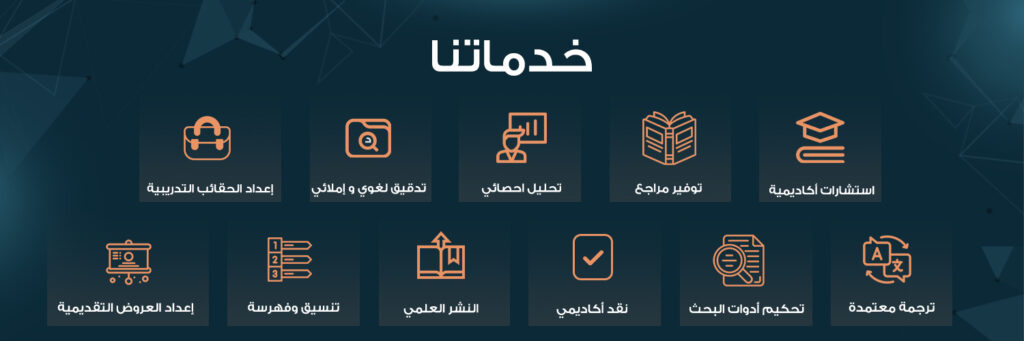
Explore Our Services






















موقع "دراسة الأفكار للبحث والتطوير" هو منصة متخصصة في تقديم الخدمات الأكاديمية والبحثية، تستهدف بشكل رئيسي طلاب الدراسات العليا.
Subscribe to our mailing list to receive all updates



© 2026 All rights reserved - دراسة الأفكار للبحث والتطوير
A technical initiative by Dirasat Al Afkar Office for Research and Development
