








Article Index
We select the best for you

Why Reviewing Previous Studies Matters in Research
29 April 2026
(17 views)
Most Viewed
Latest Articles
Categories
- Academic and Language Services
- Fundamental Concepts in Research
- Literature Review
- Master’s and Doctoral Thesis Preparation
- Previous Studies
- Referencing and Citation
- Research Methodologies
- Research Proposal
- Scientific Research Tools
- Services in Saudi Arabia
- Statistical Analysis and Discussion
- Study Abroad Programs
- Success Stories
- Theoretical Frameworks
- Translation
- Universities Guidelines
- Universities News

Previous studies are an essential part of any scientific research plan, as they provide researchers with a strong theoretical background that helps them develop their research in an organized manner. Reviewing previous studies allows the researcher to have a deeper understanding of the field they are studying, which helps them identify research gaps and avoid duplicating previous research.
In this article, we will discuss in detail the importance of reviewing previous studies in a research plan, how to search for and select them, as well as how to use and write them in a professional academic manner.
What Are Previous Studies in a Research Plan?
RepresentPrevious studiesa collection of research and scientific sources that researchers in various fields have relied upon to support their ideas and formulate new research based on available knowledge. These studies are considered a major part ofthe scientific research planas they provide the researcher with a solid knowledge base, helping them tounderstand developments in the field, identify research gaps, and formulate the research problem in a scientifically accurate manner.
Definition of Previous Studies
Refer toprevious studiesas a collection of research and scientific literature that have addressed a similar or related topic to the current research. These studies may include scientific articles, master’s and doctoral theses, research reports, and specialized books.
The Importance of Previous Studies in Scientific Research
Previous studies play a pivotal role in scientific research, as they provide the researcher with a knowledge background that helps them understand developments in the topic and guide their study in a more accurate and effective manner. Theobjectives of reviewing previous studiesare as follows:
1. Providing a Theoretical Background for the Research
Reviewing previous studies helps in forming a comprehensive understanding of the concepts and fundamental principles related to the topic, which contributes to establishing a strong theoretical framework that supports scientific research.
2. Identifying Research Gaps
Reviewing previous research helps uncover aspects that have not been studied or points that have not been addressed in depth in previous studies, which provides the researcher with an opportunity to make a new scientific contribution.
3. Guiding the Formulation of the Research Problem and Its Questions
When reviewing previous studies, the researcher can develop their own research problem based on issues that still need further study, and thus formulate clear and specific research questions.
4. Developing Research Hypotheses
By analyzing the results of previous studies, the researcher can identify general trends in the topic, which helps in building strong hypotheses based on proven scientific foundations.
5. Supporting Research Credibility and Enhancing Its Reliability
When the researcher relies on reliable scientific sources, their research becomes stronger and more credible, proving that it is built on previous scientific studies rather than just personal conclusions.
6. Benefiting from Previous Research Methodologies
Previous studies provide insight into the different research methods used by other researchers, which helps in selecting the appropriate methodology for the new study.
7. Avoiding Repetition of Previous Research
Reviewing previous studies enables the researcher to verify whether their topic has already been researched, helping them to avoid unnecessary repetition and focus on adding new value.
8. Improving the Quality of Scientific Research
Reviewing previous studies helps in developing scientific research to be more accurate and comprehensive by benefiting from the recommendations and results reached by previous research.
9. Facilitating Data Analysis and Scientific Comparisons
When conducting research, data available in previous studies can be used to compare with new results, which helps in providing a more accurate and objective analysis.
10. Providing a Reference Framework That Helps Future Researchers
When reviewing previous studies thoroughly, future researchers can use the available results and resources to develop their own research, contributing to the advancement of scientific knowledge.
✅If you need help preparing your research plan, you can benefit fromScientific Research Plan Consultation Serviceoffered by Idea Study.
Types of Previous Studies Used in Scientific Research
Previous studiesarean essential part of anyscientific researchas they help the researcherunderstand the scientific background of the topic, identify research gaps, and guide the research toward accurate resultsPrevious studies are divided into several types according to the nature of scientific research and its methodology.
1. Theoretical Studies
🔹What Are They?
They are studies that focus ontheories and conceptsrelated to the research topic, without relying on experimental or field data.
🔹Their Role in Scientific Research
✔ Supporting research with approved scientific theories and concepts.
✔ Clarifying the theoretical framework of the study and linking it to the research problem.
✔ Providing a comparative analysis between different theories related to the topic.
🔹Examples of Theoretical Studies
- Analyzing theoriesof learning in educational psychology.
- A study on the effect ofself-determination theoryon employee performance.
2. Experimental Studies
🔹What Are They?
They are research that relies onexperimentation and testingTo achieve new results by applying specific variables and monitoring their impact.
🔹Her Role in Scientific Research
✔ Providing scientific evidence through experiments and tests.
✔ Proving or refuting research hypotheses scientifically.
✔ Developing models and recommendations based on practical results.
🔹Examples of Experimental Studies
- Impact experimentE-learningon student achievement compared to traditional education.
- Testing effectivenessof a new drugto treat a specific disease through clinical trials.
3. Descriptive Studies
🔹What Are They?
They are studies that aim todescribe scientific and social phenomenawithout intervening in them, through the analysis of available data and information.
🔹Her Role in Scientific Research
✔ Providing a comprehensive picture of the research topic.
✔ Analyzing data to extract patterns and trends.
✔ Helping researchers understand problems more deeply.
🔹Examples of Descriptive Studies
- AnalysisUnemployment ratesin a specific area and its impact on the economy.
- StudySocial media usage patternsamong youth.
4. Analytical Studies
🔹What Are They?
They are research that relies onanalyzing data and informationto infer relationships and patterns between different variables.
🔹Their Role in Scientific Research
✔ Interpreting phenomena based on available data.
✔ Providing analytical models that clarify the impact of various factors.
✔ Guiding policies and strategies based on scientific analyses.
🔹Examples of Analytical Studies
- StudyCauses of climate changeand its impact on the environment.
- Analysis of the impactDigital Marketingon consumer behavior.
5. Comparative Studies
🔹What Are They?
They are studies that comparetwo or more phenomenato understand the differences and similarities between them.
🔹Their Role in Scientific Research
✔ Providing a deeper understanding of different phenomena through comparison.
✔ Identifying similarities and differences between different methods or strategies.
✔ Providing recommendations based on best practices.
🔹Examples of Comparative Studies
- Comparisonof education systems in Arab and Western countries.
- A study of the differences betweendemocratic leadership and autocratic leadershipin the workplace.
6. Historical Studies
🔹What Are They?
They are research that relies on studyingHistorical SourcesTo understand events and phenomena from a temporal perspective.
🔹Their Role in Scientific Research
✔ Analyzing past events to understand their impact on the current situation.
✔ Providing scientific insights based on historical evidence.
✔ Helping to build new scientific theories.
🔹Examples of Historical Studies
- Analysisof philosophical thoughtthroughout the ages.
- Study of the impactof the Industrial Revolutionson modern societies.
7. Field Studies
🔹What Are They?
They are studies that rely oncollecting data directly from realitythrough observation, surveys, or interviews.
🔹Their Role in Scientific Research
✔ Providing current and realistic data about the phenomenon being studied.
✔ Offering practical recommendations based on field data.
✔ Support scientific research with realistic and applicable results.
🔹Examples of Field Studies
- Study of the impactof vocational training programson the unemployment level.
- Analysis of the causesof the decline in agriculture in rural areas.
✅Learn aboutthe importance of a scientific research planand how to prepare it correctly to successfully guide your academic study.
The Importance of Reviewing Previous Studies in a Research Plan
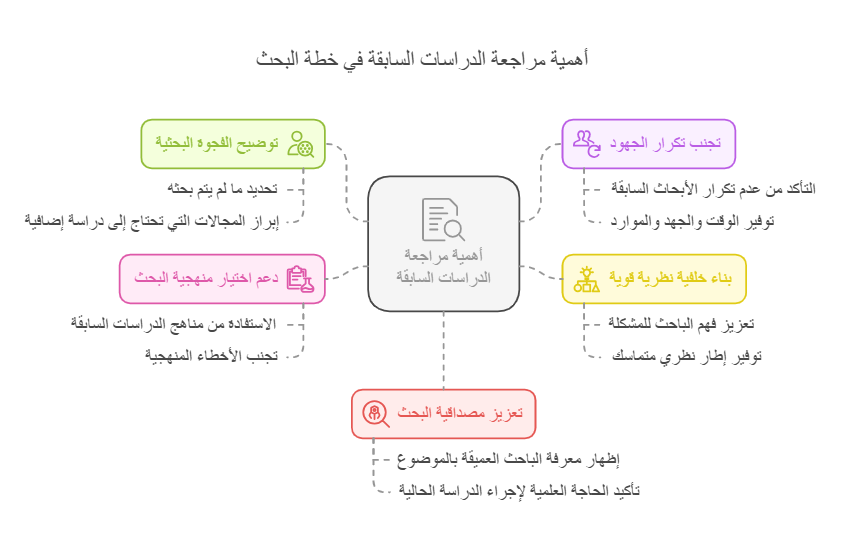
The Importance of Choosing the Appropriate Type of Previous Studies
Choosing the appropriate type of previous studies depends onthe nature of the scientific research, its objectives, and the methodology used. Therefore, the researcher must:
- Determine the type of study that suits their research topic.
- Ensurethe credibility and recency of the sourcesused.
- Usemore than one type of previous studiesto ensure comprehensive coverage of the topic.
How to Search for Appropriate Previous Studies
Reviewingprevious studiesis a fundamental step in scientific research, as it helps build the research framework, identify research gaps, and guide the researcher toward choosing a suitable methodology. However, finding appropriate studies can be challenging, especially if the researcher does not have a clear search strategy. Here are effective steps for searching for appropriate previous studies:
1️⃣ Identify Appropriate Keywords
🔹 Identify the main keywords related to your research topic.
🔹 Use differentsynonymsfor the keywords to expand the search scope.
🔹 Try searching using specialized scientific terms in the field.
Example:If you are researching the impact of technology on education, you can use terms like:
- “E-learning”
- “Technology in education”
- “Distance learning”
- “E-learning”
2️⃣ Using Academic Databases
📚Google Scholar– an academic search engine that displays scientific studies and articles.
📚PubMed– suitable for researchers in medical and health sciences.
📚JSTOR– Contains research in multiple fields.
📚IEEE Xplore– Ideal for research in engineering and technology.
📚Scopus and Web of Science– Comprehensive databases containing reliable studies.
3️⃣ Searching in Peer-reviewed Scientific Journals
🔹 CheckAcademic journalsspecialized in your research field.
🔹 Useuniversity and research center websitesto access recently published research.
🔹 UseDOAJ (Directory of Open Access Journals)to access open access journals.
4️⃣ Reviewing References in Previous Studies
🔹 Search inreference listsof relevant studies to find additional research.
🔹 These studies are often reliable and directly relevant to your research topic.
5️⃣Utilizing Digital Libraries and Research Repositories
📌You can find previous studies through digital libraries that contain master’s theses, doctoral dissertations, and published academic research.
Best Digital Libraries:
✅ProQuest Dissertations & Theses– Contains millions of academic theses
✅Shodhganga– Repository for Indian and global research
✅Ethos– British Library’s research collection
✅Library of Congress– American Library of Congress with vast digital resources
📌Tip:Some universities providefree digital repositoriesthat can be searched through the university’s official website.
6️⃣ Use Reference Management Tools
🛠Zotero– A free tool that helps in saving and organizing previous studies.
🛠Mendeley– Makes it easy to manage research and create academic citations.
🛠EndNote– Researchers use it to organize studies and create reference lists easily.
7️⃣ Communicating With Researchers and Experts
🔹 Interaction withuniversity professors and academic supervisorscan be a useful source for getting suggestions on appropriate studies.
🔹 Joiningscientific conferences and seminarscan help discover the latest research in the field.
How to Write the Previous Studies Section in a Research Proposal
Theprevious studiessection is an essential part of any scientific research plan, as it clarifies the scientific background of the topic, helps identify research gaps, and shows the researcher’s familiarity with previous research in the field. To write this section professionally, a systematic approach must be followed to ensure an organized presentation of relevant sources and references.
1️⃣ Importance of the Previous Studies Section in a Research Proposal
📌 It helps clarify thescientific contextof the research.
📌 It highlightsresearch gapsthat the researcher can address.
📌 It provides atheoretical foundationthat supports the research methodology and proposed hypotheses.
📌 Helps to avoidunnecessary researchduplication.
2️⃣ Steps for Writing the Literature Review Section in a Research Proposal
🔹 First: Select Relevant Studies
🔹 Identify research that directly relates to your topic.
🔹 Useacademic databasessuch asGoogle Scholar, PubMed, and Scopusto find reliable research.
🔹 Ensure the selected studiesare recent and peer-reviewed.
🔹 Second: Analyze and Evaluate Previous Studies
✔️ Compare results from different studies and discuss their consistency or differences.
✔️ Focus onresearch methodologiesused in previous studies.
✔️ Identifyresearch gapsnot covered by previous studies.
✔️ Highlight the most importanttheories and conceptsaddressed in previous studies.
🔹 Third: Organizing the Literature Review
There are several ways to present previous studies in research, including:
🔸Chronological Organization:
- Arranging studies from oldest to newest to showthe development of scientific knowledgeon the topic.
🔸Thematic Organization:
- Classifying studies bysubtopicsrelevant to the research.
🔸Methodological Organization:
- Classifying studies based onthe methodologies used(such as quantitative, qualitative, or experimental approaches).
Example of a thematic organization method:
| الموضوع | الدراسات السابقة | النتائج الرئيسية |
|---|---|---|
| تأثير التكنولوجيا في التعليم | دراسة (أحمد، 2020) – دراسة (محمد، 2022) | أظهرت النتائج تحسنًا في التحصيل الدراسي عند استخدام التكنولوجيا. |
| استراتيجيات التدريس الحديثة | دراسة (خالد، 2021) – دراسة (علي، 2023) | استخدام التعليم التفاعلي يزيد من دافعية الطلاب. |
🔹 Fourth: Writing an Analytical Summary of the Literature Review
The literature review section should include:
📌A brief introductionExplaining the purpose of reviewing previous studies.
📌Critically analyze studies, not just summarizing their content.
📌ConclusionExplain how your study will build on previous studies and what gaps it will address.
3️⃣ Mistakes to Avoid When Writing the Literature Review Section
❌Narration without analysis: Don’t just summarize research, provide a critical analysis of it.
❌Relying on outdated sources: Use recent sources and continuously update your references.
❌Not organizing studies: Ensure you classify research systematically to make it easier for readers to understand.
❌Not clarifying research gaps: You must highlight the importance of your research in filling existing gaps.
4️⃣ How to Write the Literature Review Section Professionally?
✅ Identify the most relevant studies for your research.
✅ Compare studies and highlight research gaps.
✅ Use effective organization methods (chronological, thematic, methodological).
✅ Write an analytical summary showing how your study will build on previous research.
📌By following these steps, you can write the literature review section in your research plan in an organized and professional academic manner, which enhances the quality of your scientific research and gives it greater credibility.🚀
Previous Studies in Scientific Research PPT
Introduction
Reviewing previous studies is an essential part of academic research and can be presented in presentationsPowerPoint (PPT)To explain its importance and how to use it academically.
PPT File Content About Previous Studies
- Definition of previous studies: What they are and how they contribute to scientific research.
- Importance of previous studiesHer role in providing theoretical background and clarifying research gaps.
- How to search for previous studies: Using academic databases such asGoogle Scholar and Scopus.
- Analysis of previous studies: Methods for critically analyzing them and classifying them according to topics.
- How to document previous studies: Methods of correct writing according to standardsAPA and MLA.
Download a PPT Presentation About Previous Studies
You can downloadPowerPoint (PPT) fileReady with a comprehensive explanation on how to use previous studies in scientific research.
Previous Studies in Scientific Research PDF
To prepare a strong scientific research, it is essential to review previous studies and understand how to benefit from them. This file providesPDFa comprehensive guide on how to search, analyze, and write previous studies in a scientific manner.
Content of the Previous Studies in Scientific Research PDF File
- Definition of previous studies and their role in scientific research.
- How to search for previous studies using academic databases.
- Criteria for evaluating the quality of previous studies.
- Method for writing previous studies in scientific research.
Download a PDF File About Previous Studies in Scientific Research
To get a comprehensive guide, you candownload a PDF file that contains everything you need to know about previous studies in academic research.
Sample Research Plan on Previous Studies
Introduction
When preparing a research plan, the sectionPrevious Studiesis an important part that helps to define the context and significance of the research.
Components of a Research Plan on Previous Studies
- Introduction: Explains the importance of previous studies in scientific research.
- Theoretical Framework: Explains the basic concepts and terms derived from previous research.
- Analysis of previous studies: A critical review of research related to the research topic.
- Identifying research gaps: Clarifying what has not been covered in previous research.
- Research methodology: How to benefit from previous studies to determine data collection methods.
- Conclusions: Summarizing the role of previous studies in shaping new research.
Research Plan Template on Previous Studies
You candownloada ready-made template for a research plan on previous studies to help you prepare your research in a professional manner.
Conclusion
Reviewing previous studies plays a fundamental role in building academic research in a scientific and methodological manner. It helps indeveloping the theoretical framework, identifying research gaps, and enhancing research credibility.Additionally, searching for and critically analyzing previous studies contributes to producing innovative research that adds value to scientific knowledge.
Therefore, researchers shouldpay attention to reviewing previous studies accurately and professionally, use reliable sources, and organize information in a scientific manner that helps them build a strong and impactful research.

Frequently Asked Questions
1. How Many Previous Studies Should Be Included in the Research Plan?
📌 The number varies depending on the academic field, but it is preferable to review10-20 studiesat least for a comprehensive analysis.
2. Can Old Studies Be Used in the Previous Studies Section?
📌 Yes, if they arebasic studiesin the field, but focus onrecent research as wellto ensure the information is up-to-date.
3. How Do I Write a Critical Analysis of Previous Studies?
📌 Compare the studies, identify strengths and weaknesses, and explain how this affects your research.
Comments
Explore Our Services






















موقع "دراسة الأفكار للبحث والتطوير" هو منصة متخصصة في تقديم الخدمات الأكاديمية والبحثية، تستهدف بشكل رئيسي طلاب الدراسات العليا.
Subscribe to our mailing list to receive all updates



© 2026 All rights reserved - دراسة الأفكار للبحث والتطوير
A technical initiative by Dirasat Al Afkar Office for Research and Development
